
The world of crypto leverage trading in the USA can multiply your gains or magnify your losses within minutes. Among the most important crypto trading tips is choosing the right platform that offers competitive margin rates, robust security features, and regulatory compliance. Whether you're searching for exchanges with high leverage ratios, low trading fees, or advanced order types, finding a platform that matches your risk tolerance and trading style makes all the difference in your success.
Coincidence AI's solution offers an AI crypto trading bot designed to help you execute strategies with precision across multiple exchanges, removing emotion from your decisions while optimizing entry and exit points. It analyses market conditions, helping you manage leveraged positions more effectively while you focus on building your overall trading knowledge and portfolio strategy.
Summary
- 78% of U.S. crypto traders cannot access leverage trading platforms due to regulatory restrictions, according to research from CaptainAltcoin. The Commodity Futures Trading Commission treats leveraged crypto products as derivatives, requiring exchanges to register and comply with extensive oversight mechanisms that most global platforms avoid because compliance costs make serving American customers economically unviable.
- Accounts using leverage above 20x experienced liquidation rates exceeding 76% within their first 90 days of trading, according to BitMEX's 2024 trading data analysis. Higher leverage doesn't improve trading outcomes. It accelerates the path to liquidation unless traders already have disciplined risk management systems in place.
- Crypto derivatives trading represents more than 70% of total cryptocurrency trading volume worldwide, according to CoinGecko's Q3 2025 report. For many traders, leverage isn't an occasional advanced feature. It's fundamental to how they approach volatility, execute hedging strategies, and capitalize on short-term price movements across multiple assets simultaneously.
- Strategy testing using historical data reveals whether trading ideas actually work before capital gets deployed. Professional trading desks don't deploy strategies without first running thousands of simulated trades, but retail traders face technical barriers that prevent proper validation.
- Slippage and execution quality affect every leveraged trade regardless of whether the strategy logic proves correct. Small execution inefficiencies of 0.14% at entry and exit across 200 trades annually compound into a significant performance drag that backtests, assuming perfect fills, never capture.
Coincidence’s AI crypto trading bot lets traders describe strategies in plain English rather than code, then backtests them across historical data, refines parameters through natural language prompts, and executes validated strategies across multiple exchanges while automatically managing position sizing, margin levels, and stop losses in real time.
Why Finding a Crypto Leverage Trading Platform in the U.S. is Difficult

The United States regulatory framework makes accessing legitimate crypto leverage trading platforms exceptionally challenging. Federal agencies enforce strict derivatives trading rules that either prohibit or severely limit the leverage products most international exchanges offer.
According to CaptainAltcoin, 78% of U.S. crypto traders are unable to access leverage trading platforms, forcing them into a frustrating search for compliant alternatives that often don't exist or offer severely restricted features.
The Regulatory Wall That Blocks Access
The Commodity Futures Trading Commission treats leveraged crypto products as derivatives, requiring exchanges to register and comply with extensive oversight mechanisms. Most global platforms choose not to pursue this registration because the compliance costs and operational restrictions make serving U.S. customers economically unviable.
When you visit a major international exchange offering 50x or 100x leverage on Bitcoin perpetuals, you'll typically see a geographic restriction blocking U.S. IP addresses or requiring identity verification that disqualifies American traders. This isn't about protecting inexperienced retail investors from themselves. The regulatory structure applies uniformly, regardless of:
- Trading experience
- Account size
- Risk-management sophistication
A professional trader with years of experience faces the same access barriers as someone opening their first derivatives position.
The Fragmented Landscape Traders Navigate
What remains accessible creates confusion rather than clarity. Some platforms offer limited margin trading with 2x or 3x leverage on spot markets. Others provide futures contracts that technically comply with U.S. regulations but restrict position sizes or require institutional account status. A few offshore exchanges accept U.S. customers in a legal gray area, operating without explicit approval but also without clear prohibition.
The Price of Existential Risk
Traders express anxiety when considering deposits on platforms that exist in this uncertain middle ground. The phrase "sleep at night knowing the exchange isn't going to disappear" captures the underlying fear. You're not just evaluating fee structures and liquidity depth. You're assessing existential risk, wondering whether regulatory action might freeze your funds or whether the platform's operational security justifies the legal ambiguity.
The Dominance of Derivatives
The demand for these products hasn't diminished despite access becoming difficult. According to CoinGecko's Q3 2025 report, crypto derivatives trading represents more than 70% of total cryptocurrency trading volume worldwide. For many traders, leverage isn't an advanced feature they use only occasionally. It's fundamental to how they:
- Approach volatility
- Execute hedging strategies
- Capitalize on short-term price movements across multiple assets simultaneously
When Manual Execution Becomes Impossible
Managing leveraged positions across the limited platforms available to U.S. traders requires constant attention. Price movements happen in seconds. Liquidation thresholds approach quickly when using even moderate 5x or 10x leverage.
If you're attempting to maintain positions across two or three different exchanges because no single platform offers the full range of trading pairs you need, the manual coordination becomes unsustainable.
The Manual Execution Trap
The familiar approach involves setting price alerts, keeping multiple browser tabs open, and manually calculating position sizes based on available margin across different accounts. As market volatility increases and you're managing positions on Bitcoin, Ethereum, and several altcoins simultaneously, execution delays compound.
You miss optimal entry points because you're still closing a position on one platform when the opportunity appears on another. Stop losses trigger late because you didn't refresh the interface quickly enough during a sudden price swing.
AI-Driven Efficiency in Crypto Trading
Solutions like Coincidence’s AI crypto trading bots address this coordination challenge by executing strategies across multiple exchanges simultaneously. The AI monitors price movements, manages position sizing based on real-time margin availability, and adjusts stop losses automatically as market conditions shift, removing the manual bottleneck that causes missed opportunities and delayed risk management when trading with leverage across fragmented platforms.
The Information Gap That Compounds Difficulty
Beyond regulatory restrictions and execution challenges, finding reliable information about which platforms actually work for U.S. traders proves surprisingly difficult. Exchange documentation often contains vague geographic restrictions without clearly stating what features remain available to American users. Reviews and comparison sites frequently feature platforms that either block U.S. access entirely or offer such limited functionality that the comparison becomes meaningless.
Navigating Risks in Unknown Exchanges
Traders explore lesser-known exchanges, trying to determine legitimacy through fragmented forum discussions and conflicting reports. The lack of centralized guidance leaves you making deposit decisions based on incomplete information, hoping the platform you choose won't suddenly restrict your account or disappear when you need to withdraw funds during volatile markets.
Related Reading
- Crypto Trading Tips
- Crypto Backtesting
- Dca Bot Vs Grid Bot
- What Is Wash Trading
- Automated Trading Over Manual Trading
- What Is Long And Short In Crypto Trading
- What Is Swing Trading Crypto
- How Does Crypto Leverage Trading Work
- Forex Crypto Trading
The Common Belief That the Best Platform is the One With the Highest Leverage

Higher leverage doesn't make you a better trader. It makes your mistakes more expensive and your wins more temporary. When platforms advertise 100x or 125x leverage, they're not offering you an advantage. They're offering you a faster route to liquidation unless you already possess the discipline and risk management systems that most traders lack.
The appeal makes sense on the surface. With 100x leverage, a $1,000 deposit controls a $100,000 position. A 2% price move in your direction doubles your account. The math feels intoxicating, especially when you're watching other traders post screenshots of massive percentage gains.
What those posts rarely show is the string of liquidated positions that preceded the winning trade, or the fact that most high-leverage accounts don't survive their first significant market reversal.
Why Leverage Multiplies Losses Faster Than Gains
Experienced traders recognize a pattern that newer participants miss. Leverage amplifies volatility in both directions, but the psychological impact isn't symmetrical. A 50% gain feels exciting. A 50% loss feels catastrophic. When you're trading with 50x leverage, a 2% move against your position wipes out your entire margin. You don't have time to:
- Adjust your thesis
- Strategically strengthen your position
- Wait for the market to recover
You get liquidated, and the capital you deposited disappears.
The Mathematical Reality of Leverage
According to research from BitMEX published in their 2024 trading data analysis, accounts using leverage above 20x experienced liquidation rates exceeding 76% within their first 90 days of trading. The platform with the highest advertised leverage isn't giving you better odds. It's giving you more rope, and most traders use it exactly as you'd expect.
What Separates Sustainable Trading From Gambling
Risk management tools determine whether you survive long enough to refine your strategy. Stop-loss orders that execute reliably during volatile price swings prevent single trades from destroying your account. Position sizing controls that automatically limit your exposure based on account balance keep you from over-leveraging during emotional decision-making moments.
These features matter infinitely more than whether the platform offers 75x or 125x maximum leverage, because they address the actual failure points that eliminate traders.
The Impact of Execution Quality and Infrastructure Reliability on Long-Term Strategy
Execution quality affects every trade you make, regardless of leverage. Slippage during high-volatility periods means your entry and exit prices differ from what you intended, eroding edge even on winning trades. Order reliability during network congestion determines whether your stop-loss actually triggers when price moves against you, or whether you discover it failed only after your position is liquidated.
Platforms that prioritize infrastructure over maximum leverage numbers give you the foundation to implement strategies that compound over time rather than spectacular wins followed by account-ending losses.
Diversification Advantage and Operational Friction of Multi-Platform Trading
Available trading pairs expand your actual opportunity set beyond whatever Bitcoin or Ethereum are doing in any given week. If your platform only offers five perpetual contracts, you're forced to trade those five assets regardless of whether they're presenting favorable setups. Access to altcoin pairs, stablecoin markets, and cross-margin options lets you deploy capital where edge exists rather than forcing trades because you're limited to major pairs everyone else is already watching.
The familiar approach involves manually monitoring positions across whatever platforms accept U.S. traders, setting price alerts, and hoping you're available when market conditions shift. As you add more positions across different exchanges, because no single platform offers everything you need, execution delays compound.
Integration of AI Automation to Eliminate Manual Bottlenecks in Multi-Exchange Trading
You're calculating position sizes on one exchange while a liquidation threshold approaches on another. Stop losses trigger late because you didn't refresh quickly enough during a price spike.
Solutions like Coincidence’s AI crypto trading bot handle this coordination by executing strategies across multiple exchanges simultaneously. The AI monitors price movements in real time, adjusts position sizing based on available margin across different platforms, and manages stop losses automatically as volatility shifts, removing the manual bottleneck that causes missed entries and delayed risk protection when trading with leverage across fragmented accounts.
When Testing Capabilities Matter More Than Leverage Limits
Strategy testing using historical data reveals whether your trading ideas actually work before you risk capital. Backtesting shows you how your approach would have performed during previous market cycles, including periods of extreme volatility that liquidate over-leveraged positions.
Forward testing in paper trading environments lets you validate execution logic and risk parameters without real money at stake. Platforms offering these capabilities help you develop an edge systematically rather than learning through expensive trial and error with high leverage.
The Psychology of Algorithmic Discipline
Automation tools remove emotional decision-making from the execution process. Fear makes you exit winning trades too early. Greed makes you hold losing positions too long. Hope makes you add to losing trades instead of cutting them. Automated systems execute your predetermined rules regardless of how the market feels in the moment, maintaining discipline when manual trading would break down under stress.
Consistency matters far more than maximum leverage when you're trying to compound returns over months and years rather than chasing lottery-ticket outcomes.
Survival Over Spectacle
The platform advertising the highest leverage number is optimizing for attention, not your success. They know big numbers attract deposits from traders who haven't yet learned that survival precedes profit. The platforms worth using optimize for the infrastructure that lets disciplined traders implement repeatable processes, because that's what actually generates sustainable results in leveraged crypto markets.
The Real Challenge: Turning Trading Ideas Into Testable Strategies

Most trading ideas never get tested properly. A trader believes certain indicator combinations work during high volatility, or that specific entry patterns perform consistently when Bitcoin breaks key levels. Without systematic validation, these remain assumptions. In leveraged markets where a 3% move can liquidate a position, untested strategies don't just underperform. They destroy accounts.
Professional trading desks don't deploy ideas directly into live markets. According to the CFA Institute's 2026 research on systematic trading, quantitative teams use backtesting as a core validation step before allocating capital.
- They write scripts
- They run historical simulations
- They adjust parameters
- They analyze performance metrics like maximum drawdown and win rate across different market regimes.
This process separates ideas that survive volatility from those that only performed well under favorable conditions.
The Technical Barrier to Entry
Individual traders face a different reality. The tools that enable systematic testing require programming knowledge that most people don't have. Python libraries for backtesting, Pine Script for TradingView strategies, and API integrations for live data feeds. The barrier isn't conceptual.
Traders understand why testing matters. The barrier is technical. You can recognize that a strategy needs validation across 2021's bull run, 2022's bear market, and 2023's range-bound chop, but if you can't code the logic to run those simulations, the insight remains theoretical.
The Gap Between Conviction and Validation
When I tried to manually test a breakout strategy on historical Bitcoin data, the process took three days to generate just 50 trades. I had to:
- Scroll through charts
- Identify setups that matched my criteria
- Record entry and exit prices in a spreadsheet
- Calculate profit and loss for each position
- Aggregate the results
By the time I finished, I had no confidence that the sample size meant anything, and market conditions had already shifted enough that the original thesis felt outdated.
The Volatility-Profitability Paradox
Research from the Bank for International Settlements shows that retail traders increase trading frequency during high-volatility periods but struggle to achieve consistent profitability. The pattern makes sense. Volatility creates obvious opportunities. Prices swing 5% in an hour. Breakouts look clean. FOMO intensifies.
The Importance of Systematic Testing
Without systematic testing showing how often those breakouts fail or how volatility affects your risk-reward ratio, you're trading shapes on a chart instead of a validated edge. The familiar approach involves:
- Manual journaling
- Reviewing past trades in spreadsheets
- Identifying patterns in your execution history
As you add more positions across different timeframes and assets, the analysis becomes impossible to keep up with. You're trying to remember why you entered a position two weeks ago while simultaneously calculating whether your current drawdown exceeds acceptable risk parameters. Pattern recognition happens slowly. Market moves happen fast.
Removing Barriers with AI-Driven Trading
Solutions like Coincidence’s AI crypto trading bot remove the coding barrier by letting traders define strategy logic through AI prompts rather than programming languages. The system automatically:
- Runs backtests on historical data.
- Test strategies in live market conditions with virtual capital.
- Provides performance metrics without requiring Python knowledge.
This shifts the focus from technical implementation to strategy refinement, allowing traders to iterate on trading ideas rather than wrestling with infrastructure.
When Untested Strategies Meet Leverage
Leverage amplifies the cost of operating on assumptions. A spot trader with an untested strategy might lose 2% on a bad trade. A trader using 10x leverage loses 20%. The same flawed logic, but the financial consequence arrives ten times faster.
According to data shared in systematic trading communities, traders who deploy automated strategies without proper validation often experience what one developer called "brutal" losses, in which untested bots execute trades that looked logical in theory but fail immediately in live conditions.
The Trap of Anecdotal Patterns
Testing gap creates a specific failure mode. You build a strategy around a pattern you've observed. Maybe you noticed that when Ethereum's funding rate exceeds 0.1% and RSI drops below 30, the price tends to bounce within four hours. The observation might be accurate for the 15 instances you remember.
But without testing across hundreds of occurrences spanning different volatility regimes, you don't know if you're identifying a genuine edge or cherry-picking favorable examples your memory retained while forgetting the failures.
The Erosion of Negative Expectancy
A 5% stop loss prevents catastrophic single-trade losses. It doesn't prevent death by a thousand cuts when your strategy has a negative expectancy you never measured. Fees accumulate. Slippage compounds. Small losses stack up across dozens of trades before you realize the approach doesn't actually work. By then, you've spent weeks executing a fundamentally flawed system with leverage multiplying every mistake.
The Iteration Problem Nobody Discusses
Testing reveals flaws, but fixing them creates a new challenge. Every adjustment requires rewriting code, redeploying systems, restarting processes, and re-running backtests. One trader described this iteration friction as the most frustrating part of developing automated strategies. A simple change to an entry threshold meant:
- Editing scripts
- Waiting for backtests to complete
- Discovering the modification created new problems
- Repeating the cycle
The Glacial Pace of Manual Iteration
Each iteration consumed hours. Progress felt glacial. Manual testing doesn't solve this. Scrolling through charts to validate a modified strategy takes even longer than the original test. You're essentially starting from scratch each time you adjust a parameter, with no systematic way to compare version A against version B across identical market conditions.
Professional desks solve this with dedicated infrastructure teams. Individual traders just give up and trade discretionally, accepting inconsistency because the alternative feels technically impossible.
The platforms that advertise high leverage want you focused on position size, not on process quality. But which specific platforms actually serve U.S. traders while providing the infrastructure that matters?
6 Best Crypto Leverage Trading Platforms for U.S. Traders
1. Kraken
Kraken operates under U.S. regulatory oversight and provides margin trading with up to 5x leverage across more than 150 trading pairs. The platform supports both isolated margin, where each position maintains separate collateral, and cross-margin, where your entire account balance backs all open positions.
This flexibility matters when you're managing multiple positions simultaneously and need precise control over risk exposure for each trade.
The Resilience of Proven Infrastructure
Traders choose Kraken for reasons beyond leverage limits. The exchange maintained operational stability during the March 2023 banking crisis when several competitors faced liquidity problems. Order execution remains consistent during high-volatility periods when other platforms experience slippage or delayed fills.
The advanced order types include stop-loss, take-profit, and trailing stops that execute reliably rather than failing during the exact moments you need protection most.
The Liquidity Efficiency Standard
Deep liquidity on major pairs like BTC/USD and ETH/USD means your orders fill at prices close to your intended price. On smaller exchanges, a $50,000 Bitcoin order might move the market by 0.3% against you before it fills. On Kraken, that same order typically experiences minimal slippage because sufficient depth exists on both sides of the order book.
2. Coinbase Advanced Trade
Coinbase prioritizes regulatory compliance over maximum leverage, which creates both limitations and advantages. The platform recently announced plans to introduce CFTC-regulated perpetual futures for U.S. customers, signaling expansion into derivatives products that meet federal oversight requirements.
Current offerings focus on spot margin trading, with lower leverage ratios than those offered by international competitors.
The Importance of Asset Safety
The institutional-grade custody infrastructure matters more than promotional materials suggest. Your funds sit in segregated accounts with insurance coverage and regular attestations. When you're holding six-figure positions, knowing the exchange maintains proper separation between customer assets and operational funds affects whether you sleep well or constantly check your phone at 3 AM, wondering if your capital still exists.
Streamlined Trading With Integrated Solutions
Professional traders use Coinbase Advanced Trade for its integration with the broader Coinbase ecosystem. If you're running a strategy that requires moving capital among cold storage, active trading positions, and stablecoin yields, the unified infrastructure removes the friction of coordinating across multiple unrelated platforms.
3. Gemini ActiveTrader
Gemini operates under the New York Department of Financial Services regulation, which imposes stricter oversight than most federal frameworks require. The platform offers margin trading with up to 5x leverage and supports several major cryptocurrencies as collateral. This regulatory positioning attracts traders who prioritize legal clarity over maximum flexibility.
The ActiveTrader interface provides advanced charting, multiple order types, and real-time market data without requiring separate professional accounts or minimum balance thresholds. You get institutional-quality tools regardless of account size, which matters when you're refining strategies before scaling capital allocation.
The Role of Regulatory Oversight in Trading
Traders who experienced the FTX collapse in November 2022 now evaluate exchanges differently. Regulatory oversight doesn't guarantee safety, but it creates accountability mechanisms and audit requirements that reduce certain categories of risk. Gemini's positioning under NYDFS supervision provides transparency that offshore alternatives can't match.
4. KuCoin
KuCoin offers margin trading across hundreds of altcoin pairs not available on U.S.-regulated exchanges. If your strategy involves trading mid-cap tokens during volatility spikes, the asset coverage matters more than whether the platform operates under American regulatory frameworks. The exchange accepts U.S. customers in a legal gray area, neither explicitly approved nor clearly prohibited under current enforcement priorities.
Personalized Risk Assessment in Trading
The risk calculation becomes personal rather than universal. Some traders accept the regulatory ambiguity because their strategies require access to assets unavailable elsewhere. Others avoid the platform entirely because potential account freezes or regulatory actions create unacceptable uncertainty regardless of trading advantages.
API integrations and automated trading support make KuCoin popular among traders running systematic strategies. The platform provides:Comprehensive documentation, reliable WebSocket feeds, and order execution endpoints that respond consistently during high-volume periods.
5. Bybit
Bybit specializes in derivatives trading with deep liquidity across perpetual contracts and futures markets. The platform focuses on professional traders who understand leverage mechanics and risk management rather than retail participants exploring crypto for the first time. This specialization shows in the interface design, which prioritizes functionality over simplicity.
Precision Control with Advanced Order Types
Advanced order types include conditional orders, time-in-force specifications, and position management tools that let you adjust leverage, add margin, or modify stops without closing and reopening positions. These capabilities matter when you're managing multiple leveraged positions across different assets and need precise control without manual recalculation for each adjustment.
The platform operates outside U.S. regulatory frameworks, creating the same legal ambiguity that exists with KuCoin. Traders use VPNs and offshore entities to access the platform, accepting compliance risk in exchange for trading infrastructure that domestic alternatives don't provide.
6. BitMEX
BitMEX pioneered crypto derivatives trading and maintains relevance among experienced traders despite regulatory challenges that limited its U.S. operations. The platform settled with the CFTC in 2021 over past violations, but continues to operate with geographic restrictions for American users.
The derivatives-focused infrastructure provides tools specifically designed for leveraged trading rather than spot markets, with margin features added later. Position management, liquidation engines, and risk calculations reflect years of refinement based on how professional traders actually use leverage in volatile markets.
A Historical Trading Foundation
Traders who access BitMEX typically do so through offshore structures or by accepting the regulatory gray area. The platform's historical role in crypto derivatives markets means many professional strategies were originally developed and tested using BitMEX infrastructure, creating path dependency that keeps experienced traders engaged despite easier alternatives.
Challenges of Manual Risk Management
The familiar approach involves manually monitoring positions across whichever platforms accept your jurisdiction, setting alerts on each exchange separately, and hoping you're available when liquidation thresholds approach. As you scale across multiple assets and timeframes, coordination breaks down. You're calculating margin requirements on Kraken while a position on KuCoin approaches its stop loss. Risk management becomes reactive instead of systematic.
AI Solutions for Coordinated Trading
Coincidence’s AI crypto trading bot executes strategies across multiple exchanges simultaneously, monitoring margin levels, adjusting positions based on real-time volatility, and managing stops automatically as market conditions shift. The AI handles coordination that's impossible to do manually when you're running leveraged positions across platforms with different:
- Margin requirements
- Liquidation mechanics
- Order execution speeds
The Selection Criteria That Actually Matter
Platform choice depends on which constraints you're willing to accept. Regulatory clarity costs you asset coverage and limits on leverage. Maximum flexibility costs you legal certainty and potential account stability. Deep liquidity on major pairs costs you access to emerging altcoins. No platform provides everything simultaneously.
Diverse Strategies Demand Specialized Exchanges
Experienced traders often use multiple exchanges, not because they're indecisive, but because different strategies require different infrastructure. A Bitcoin volatility strategy runs on Kraken for regulatory compliance and execution reliability. An altcoin momentum strategy runs on KuCoin for asset coverage. A derivatives hedging strategy runs on Bybit for liquidity depth and advanced position management.
The real question isn't which platform is best. It's which combination of platforms provides the infrastructure your specific strategies require while staying within risk tolerances you can actually maintain during periods when everything moves against you simultaneously.
Related Reading
- What Is OTC Trading Crypto
- What Are Crypto Trading Signals
- Most Profitable Crypto Trading Strategy
- Best App For Crypto Day Trading
- Best Crypto to Day Trade
- Best Crypto Copy Trading Platform
- Best Crypto Trading Tools
- Crypto Futures Trading for Beginners
- Crypto Day Trading Strategies
- Advanced Crypto Trading Strategies
What the Best Crypto Leverage Trading Platforms Actually Provide

After reviewing available platforms, experienced traders evaluate infrastructure that supports disciplined strategy development rather than maximum leverage numbers. The tools surrounding leverage determine whether positions survive volatility or liquidate during the exact moments when manual intervention becomes impossible.
Platforms worth using provide backtesting capabilities, risk management automation, reliable execution during high-volume periods, and liquidity depth that prevents slippage from eroding edge before trades even complete.
Backtesting Infrastructure That Validates Ideas Before Capital Deployment
Testing strategies against historical data reveals whether trading logic actually works across different market regimes. A breakout strategy that performed well during 2021's bull run might fail catastrophically during 2022's sustained downtrend or 2023's range-bound conditions.
Backtesting shows you maximum drawdown periods, win rates across different volatility environments, and whether your stop-loss placement actually protects capital or just guarantees small losses that accumulate faster than wins compound.
The Necessity of Simulation Infrastructure and Positive Expectancy Validation
Professional trading operations don't deploy strategies without first running thousands of simulated trades. According to Gate.com's analysis of leverage trading platforms, some exchanges advertise 100x leverage while providing minimal testing infrastructure, creating a dangerous combination where traders can access extreme position sizes without validating whether their approach has positive expectancy.
Retail traders deserve the same validation tools institutional desks use, not just access to leverage that amplifies untested assumptions.
The Cost of Unvalidated Ideas
You think funding rate patterns predict Bitcoin reversals. Without backtesting across 500 occurrences spanning three years, you're operating on pattern recognition from the 12 instances you remember. Your brain retained the times it worked. The failures disappeared from memory. Testing forces you to confront actual performance rather than selective recall.
Risk Controls That Execute When Manual Intervention Fails
Stop-loss orders only protect you if they trigger reliably during the exact volatile conditions when you need protection most. Platform infrastructure determines whether your 5% stop executes at 5.1% during normal trading or slips to 8% during a sudden price cascade when liquidations trigger across multiple exchanges simultaneously.
Order execution quality during stress periods separates platforms that provide actual risk management from those offering theoretical protection that fails when tested.
The Emotional Shield of Automated Logic
Position sizing automation prevents the emotional decision-making that destroys leveraged accounts. When Bitcoin drops 15% in two hours, and your position shows a 40% unrealized loss, fear makes you either panic-close at the worst possible moment or freeze completely, hoping for recovery that never arrives.
Automated systems adjust position sizes based on predefined volatility parameters and account balance, removing the psychological component that causes traders to over-leverage during euphoria and under-leverage during fear.
The High Cost of Cognitive Overload
Traders often describe feeling overwhelmed when managing multiple leveraged positions across different exchanges during volatile periods. Manual coordination breaks down when you're calculating margin requirements on one platform while liquidation thresholds approach on another. The familiar approach involves:
- Setting price alerts
- Keeping browser tabs open
- Hoping you're available when market conditions shift against you.
As positions multiply across Bitcoin, Ethereum, and altcoin pairs, execution delays compound into missed stops and unintended liquidations.
Coincidence’s AI crypto trading bot handles coordination across multiple exchanges simultaneously, monitoring margin levels in real time, adjusting stops automatically as volatility shifts, and managing position sizing based on available capital across different platforms. The AI executes predefined risk rules without the emotional interference that causes manual traders to override their own strategies during periods of market stress.
Execution Quality That Preserves Edge
Slippage erodes profitability on every trade regardless of whether your strategy logic proves correct. You identify a Bitcoin entry at $43,250 based on support confluence. Your order fills at $43,310 because insufficient liquidity existed at your target price. That 0.14% difference seems minor until you realize it happens on both entry and exit across 200 trades annually.
Small execution inefficiencies compound into significant performance drag that backtests never captured because they assumed perfect fills.
The Precision of Deep Liquidity
Platforms connected to deep liquidity pools provide price stability that matters more as position sizes grow. A $5,000 market order in a thin order book might move the price 0.5% against you before it completes. The same order on an exchange with institutional market makers fills within 0.05% of the mid-price. This execution advantage becomes critical when trading with leverage, where entry precision directly determines how much room there is before stop-loss levels are triggered.
The Reliability of Chaotic Execution
Order reliability during network congestion determines whether risk management actually functions. During March 2020's COVID crash, some exchanges experienced order submission delays exceeding 30 seconds. Traders watched positions liquidate as they frantically clicked buttons that didn't respond. Infrastructure quality reveals itself during chaos, not during calm periods when everything works smoothly.
Liquidity Depth Across Trading Pairs
Access to liquid markets for both major and mid-cap assets expands the opportunity set beyond whatever Bitcoin happens to be doing. If your platform only offers five perpetual contracts, you're forced to trade those five regardless of whether favorable setups exist.
Platforms that provide dozens of liquid pairs let you deploy capital where the edge appears, rather than forcing trades because of limited options. According to Ventureburn's review of margin trading exchanges, some platforms advertise 200x leverage but only provide it on Bitcoin and Ethereum pairs, creating a misleading impression of flexibility.
Leverage without corresponding asset coverage doesn't expand trading possibilities. It just concentrates risk into fewer markets where everyone else is already watching the same patterns.
The Altcoin Liquidity Trap
Altcoin liquidity matters differently from Bitcoin depth. A $10,000 order in BTC/USDT barely registers on major exchanges. The same dollar amount in a mid-cap altcoin pair might represent 5% of daily volume, creating a price impact that makes the trade uneconomical before considering whether the directional thesis proves correct.
Platforms that maintain maker liquidity across diverse assets through market maker incentives provide execution quality that smaller exchanges can't match.
Automation That Removes Emotional Override
Systematic execution follows predefined rules regardless of how the market feels in the moment. Fear makes you exit winning trades early because you're terrified of giving back profits. Greed makes you hold losing positions too long because admitting the trade failed feels worse than watching losses grow.
Automation removes these psychological failure points by executing logic you defined during calm analysis rather than emotional reaction during volatility.
The Power of Systematic Compounding
Strategy consistency compounds over time in ways that discretionary trading never achieves. A systematic approach with 55% win rate and disciplined risk management generates steady returns. The same logic applied inconsistently, with emotional overrides during drawdown periods, produces erratic results that feel like gambling rather than edge execution.
Platforms enabling automation help traders maintain discipline when manual execution would break down under stress. But infrastructure only matters if you can actually implement strategies that use it effectively.
Related Reading
- Best Crypto Prop Trading Firms
- Best Crypto Options Trading Platform
- Best Crypto Paper Trading
- Best Crypto Trading Simulator
- Coinrule Alternative
- Cryptohopper vs 3Commas
- HaasOnline vs 3Commas
How Coincidence AI Helps Traders Build Leverage Strategies
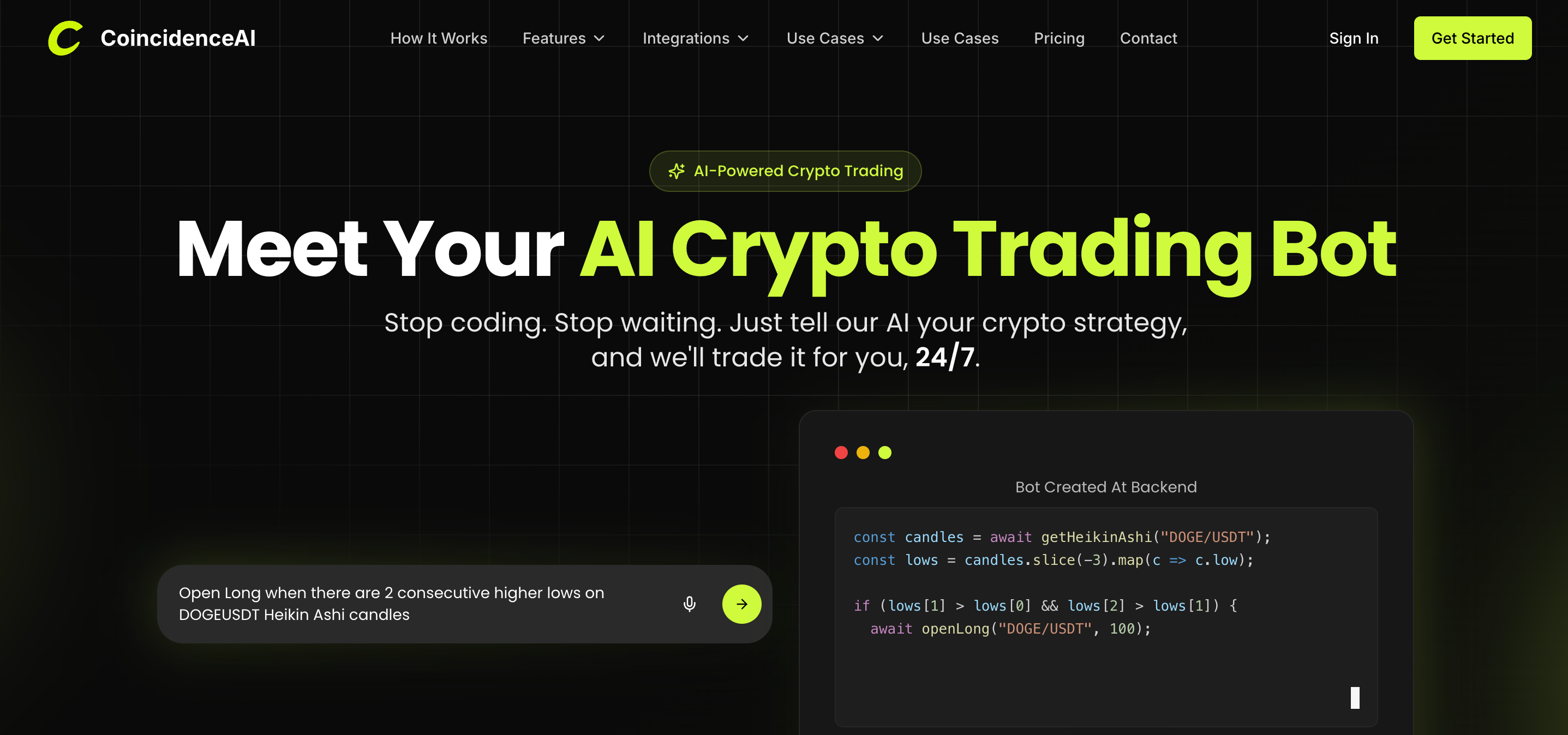
Once traders choose a leverage trading platform, the next challenge is turning trading ideas into strategies that can be tested and executed consistently. Most algorithmic trading tools require programming knowledge, forcing traders to translate their ideas into code before they can test them. For traders who think in terms of strategy rather than programming syntax, this step becomes a major barrier. Coincidence AI focuses on removing that barrier.
Strategy Creation Through Conversation, Not Code
Instead of writing scripts or learning programming languages, traders can simply describe their strategy in plain English. A trader might write: "Buy Bitcoin when the 50-day moving average crosses above the 200-day average and RSI is below 60." Coincidence AI converts that description into a structured trading strategy that can be tested and refined.
Challenges of Traditional Automated Trading
The difference matters more than it appears. Traditional automated trading requires you to learn Python, understand API documentation, manage data feeds, and debug code when something breaks. Each of these steps consumes time that could be spent refining strategy logic or analyzing market patterns.
When the barrier to testing an idea drops from hours of coding to minutes of description and iteration, iteration speed increases dramatically.
According to Forbes-Dell Technologies BrandVoice, algorithmic trading revenues hit $10.4B in 2024, reflecting how institutional traders have long used automated systems to execute complex strategies. That same capability now becomes accessible without requiring institutional infrastructure or programming teams.
From Description to Deployment
After describing a strategy, traders move through a complete development workflow.
- Instantly backtest the strategy using historical market data across different volatility regimes.
- Analyze key performance metrics, including win rate, maximum drawdown, and risk exposure.
- Refine strategy rules using natural language prompts rather than rewriting code.
- Deploy strategies live to exchanges such as Bybit and KuCoin once validation confirms the approach works.
This process allows traders to focus on strategy design rather than coding complexity. The familiar approach involves manually testing ideas by:
- Scrolling through charts
- Recording results in spreadsheets
- Trying to execute trades consistently while managing positions across multiple exchanges.
As market conditions shift and you're running leveraged positions on Bitcoin, Ethereum, and several altcoins simultaneously, manual execution breaks down. You're calculating position sizes on one platform while liquidation thresholds approach on another.
Automated Coordination for Leverage Trading
Coincidence’s AI crypto trading bot executes strategies across multiple exchanges simultaneously, monitoring price movements in real time, adjusting position sizing based on available margin, and managing stop losses automatically as volatility shifts. The AI handles coordination that becomes impossible manually when trading with leverage across platforms with different margin requirements and liquidation mechanics.
Testing That Reveals What Actually Works
Backtesting assesses whether a strategy performs under varying market conditions before capital is deployed. A momentum strategy that worked during 2021's bull run might liquidate positions repeatedly during 2022's bear market. Testing across both periods reveals whether the approach has a genuine edge or just benefited from the favorable conditions your memory retained while forgetting the failures.
The system runs simulations across thousands of trades, measuring not just win rate but maximum drawdown periods, average holding times, and how often stop losses trigger versus profit targets. These metrics reveal whether a strategy generates consistent returns or produces erratic results that feel like gambling rather than systematic edge execution.
The Zero-Code Iteration Loop
Refinement occurs through the same natural-language interface used for initial creation. If backtesting shows excessive drawdowns during high-volatility periods, you might adjust by adding: "Reduce position size by 50% when Bitcoin's 30-day volatility exceeds 4%." The system incorporates the modification, reruns the backtest, and shows updated performance metrics. No code editing required.
Live Execution That Maintains Discipline
After validation, strategies are deployed to live markets with the same logic that performed well in testing. The AI monitors market conditions continuously, executing entries when criteria match, adjusting stops as price moves, and closing positions when exit signals trigger. This removes the emotional override that causes manual traders to deviate from their own rules during periods of fear or greed.
The Future of Algorithmic Trading
Research from Forbes - Dell Technologies BrandVoice indicates that algorithmic trading revenues are projected to grow to $16B by 2030, driven by traders recognizing that systematic execution compounds edge over time in ways that discretionary trading never achieves. A strategy with 55% win rate and disciplined risk management generates steady returns.
The Automated Multi-Venue Orchestrator
Multi-exchange coordination becomes automatic rather than manual. If your strategy trades Bitcoin on Kraken, Ethereum on Coinbase, and altcoins on KuCoin, the AI manages positions across all three simultaneously. Margin levels get monitored in real time. Stop losses adjust based on volatility across different assets.
Position sizing scales based on available capital across separate accounts. The coordination that breaks down manually when managing leveraged positions across fragmented platforms happens systematically.
Trade With Plain English With Our AI Crypto Trading Bot
The best leverage trading platform isn't the one offering 125x multipliers or the most trading pairs. It's the one that lets you test whether your actual trading ideas work before capital gets deployed, then executes those strategies consistently across multiple exchanges without requiring you to become a programmer first.
With Coincidence AI, you describe a strategy the same way you'd explain it to another trader. "Buy Ethereum when funding rate exceeds 0.08% and price breaks above the 20-period moving average on the 4-hour chart."
AI-Driven Strategy Validation and Execution
The AI converts that description into structured logic, backtests it across historical data spanning different volatility regimes, and shows you whether the approach actually generates positive returns or just looked good during the specific market conditions you remember. Once validated, the strategy deploys live to exchanges like Bybit and KuCoin, executing entries and exits based on your rules rather than emotional reactions during volatile price swings.
This removes the barrier that prevents most traders from moving beyond discretionary execution. You don't need to learn Python syntax, debug API connections, or figure out how to structure conditional logic in code.
Reclaiming Strategic Bandwidth
The time you'd spend wrestling with technical implementation gets redirected toward what actually matters:
- Refining strategy parameters.
- Analyzing performance across different market conditions.
- Identifying which approaches survive drawdown periods versus those that only work during favorable trends.
Start building your strategy today or book a demo to see Coincidence AI run on a real trading idea. The platform you choose matters less than whether it helps you answer the fundamental question every leveraged trader faces: Does this strategy actually work, or am I just gambling with borrowed capital?