

You're watching Bitcoin surge while your portfolio sits still, and suddenly your inbox floods with "guaranteed profit" alerts promising the moon. When it comes to Crypto trading tips, few topics spark more confusion or more costly mistakes than understanding what Crypto trading signals are and how to use them safely. These buy-and-sell recommendations can either guide your decisions or mislead you. This article explains the mechanics behind these alerts, how they work, and, most importantly, why even experienced traders often misuse them in ways that damage their returns.
Understanding signal types, sources, and proper implementation becomes easier with the right tools. Coincidence AI's AI crypto trading bot helps you evaluate and act on trading signals with precision, removing the emotional guesswork that causes traders to chase pumps, ignore risk management, or blindly follow unverified signal providers without understanding the underlying market conditions that make those signals valid or worthless.
Summary
- Crypto trading signals typically fail most often during execution, not during analysis. Research shows that retail traders who follow third-party signals underperform basic buy-and-hold strategies by an average of 18% over six months, largely due to execution delays and emotional overtrading after losses.
- Most signals provide conclusions without revealing the analytical framework that produced them. You receive clear instructions such as "Long ETH at $2,450, stop $2,410," but you never learn whether the setup originated from technical breakouts, on-chain accumulation, or derivatives positioning.
- Position sizing misalignment causes silent portfolio damage that traders rarely connect to signal quality. A recommendation might suggest risking $500 on a trade, which represents 1% risk for a $50,000 account but 5% risk for a $10,000 account. Signals assume standardized exposure that doesn't exist in reality, and without personalized sizing rules that adjust for account size and current volatility, even winning setups can produce unacceptable drawdowns.
- Backtesting reveals performance gaps that marketing materials deliberately hide. Proper historical validation accounts for slippage, spreads, and execution delays rather than assuming instant fills at theoretical signal prices. The performance gap between theory and real-world execution often erodes profitability entirely, which explains why strategies that look impressive in highlight reels often fail when followers apply them with real capital under live market conditions.
- Signal dependency erodes independent judgment over time, creating behavioral patterns that damage accounts more than bad trade ideas. According to analysis from multiple trading research sources, 90% of day traders lose money largely because execution quality, risk control, and emotional discipline remain inconsistent even when the underlying signals are soundly analyzed.
AI crypto trading bot addresses this by automating the entire execution layer, evaluating signals against predefined risk parameters, current portfolio exposure, and real-time market conditions across multiple exchanges without the emotional override that breaks manual signal followers.
The Promise of Easy Profits From Signals
Crypto trading signals promise a simple path: follow the alert, execute the trade, collect the profit. In a market that never sleeps and swings violently within minutes, that promise feels like oxygen.
You don't need to:
- Master technical analysis
- Monitor charts around the clock
- Build a system from scratch
Just wait for:
- The notification
- Copy the setup
- Move on with your day
How to Audit a Signal
The appeal is obvious. Signals arrive as clean instructions:
- Buy this coin at this price
- Sell at these targets
- Cut losses here
Delivered through Telegram channels, Discord servers, or mobile apps, they feel like having a professional trader whispering in your ear. For beginners overwhelmed by candlestick patterns and order books, or busy professionals who can't watch markets full-time, signals offer instant clarity in chaos.
Distinguishing Expertise From Exit Liquidity
That accessibility drives their popularity. You don't need deep market knowledge or expensive tools. The format is plug-and-play. Providers often label trades as “high probability” or “low risk,” reinforcing the perception that outcomes are predictable. Some even offer free trial signals that perform well, creating the impression that the expertise is genuine and the results are consistent.
Why the Reality Diverges
The trading experience rarely matches the marketing. Prices move fast. By the time you see the notification, check the chart, and place your order, the entry point has shifted. What looked like a clean setup at $42,500 is now $42,680, and your risk-reward ratio just collapsed.
Two different signal providers might issue opposite recommendations on the same asset within hours. One calls for a long position, another warns of a breakdown. Both claim high confidence.
Why Easy Rules Lead to Hard Emotions
Most signals lack context about broader market conditions. They don't account for your portfolio exposure, your risk tolerance, or whether volatility is spiking across the entire market. You're given a trade setup without understanding why it matters now, or what invalidates it later.
When a trade fails, the emotional response becomes the real problem. Traders chase the next signal to recover losses, increase position sizes to “make it back faster,” or abandon stop-losses because this one “feels different.”
Why Signals Fail in the Last Mile
That reactive cycle produces inconsistent results. According to a 2023 analysis by CryptoCompare, retail traders following third-party signals underperformed basic buy-and-hold strategies by an average of 18% over six months, largely due to execution delays and emotional overtrading after losses.
The pattern is common:
- A few wins build confidence
- A string of losses triggers desperation
- The original discipline evaporates
The Core Structural Problem
The issue isn't that signals never work. Some providers offer legitimate analysis.
The problem is that signals promise simplicity without addressing:
- Execution realities
- Risk management
- Changing market dynamics
They treat trading as if it's purely informational, when the harder challenges are behavioral and operational.
The Static Signal vs. the Dynamic Market
You receive an alert suggesting a long position in Bitcoin at $43,200 with a stop at $42,800. Sounds clear.
- But what if you're already holding three other positions?
- What if market volatility just doubled and your usual risk per trade no longer makes sense?
- What if you're asleep when the signal arrives, and by the time you wake up, the price is at $43,950? The signal didn't account for any of that.
It assumed:
- Perfect conditions
- Instant execution
- Zero emotional interference
The Rise of Systematic Execution
Platforms like Coincidence AI's AI crypto trading bot address this gap by automating signal execution across multiple exchanges.
Instead of manually reacting to alerts, the system evaluates signals against your:
- Predefined risk parameters
- Current portfolio exposure
- Real-time market conditions
It then executes systematically without delay or emotion. This shifts the challenge from “did I see the signal in time?” to “is my strategy sound and consistently applied?”
When Signals Feel Like Relief
The emotional pull of signals is strongest when you feel overwhelmed. Markets move 24/7. News breaks at 3 a.m. A coin you've never heard of pumps 40% while you're at work.
The idea that someone else is watching, analyzing, and alerting you feels like relief. It's the promise of not being alone in the chaos.
Why Signal Results Look Better Than They Are
That feeling is real, and it's why signal services attract so many users. But relief isn't the same as reliability. The comfort of having guidance doesn't guarantee the guidance is sound, timely, or suited to your situation.
Many traders describe feeling “eager” and “desperate” to start, especially after seeing a few successful free signals. That eagerness often leads to skipping due diligence, trusting large subscriber counts as proof of legitimacy, or believing that "no upfront fee, just payment after profit" means low risk.
Why “Good” Signals Fail on "Bad" Exchanges
But the structure rarely delivers consistent reliability without deeper systems around execution, risk control, and emotional discipline. Signals provide information, but information alone doesn't solve the operational and psychological challenges that determine actual trading outcomes.
But understanding what signals are supposed to do is only half the picture.
What Crypto Trading Signals Actually Are and Aren’t
A crypto trading signal is a trade recommendation based on analysis of market data. It tells you that someone or something has evaluated price action, volume, indicators, or other inputs and concluded an asset is likely to move in a specific direction.
The signal provides an:
- Entry point
- Exit targets
- A stop-loss level
That's the mechanical definition. But what you're actually receiving is the output of an analytical process, not the process itself.
The Inputs Behind Signal Generation
Signals don't materialize from intuition. They come from specific data sources that vary widely.
Technical analysis signals rely on:
- Chart patterns
- Moving averages
- RSI divergences
- Support and resistance levels
- Breakout formations
Someone watches Bitcoin test $42,000 three times, sees volume declining on each test, and issues a short signal expecting a breakdown.
Reading the Engine of the Market
On-chain signals track blockchain activity. Whale wallet movements, exchange inflows suggesting selling pressure, or stablecoin transfers indicating buying power building up. When 10,000 BTC suddenly moves from cold storage to an exchange, that's data. Whether it means imminent sale or just repositioning is a matter of interpretation.
Derivatives data offers another layer. A spike in funding rates is a positive signal that overleveraged longs are vulnerable to liquidation. Open interest climbing while price consolidates suggests a significant move is coming, though direction remains unclear until it breaks out.
The Triple-Confirmation Method: Finding Signal Confluence
Sentiment signals are scraped from:
- Social media
- News headlines
- Fear-and-greed indexes
A sudden surge in retail enthusiasm on Twitter might trigger a contrarian short signal, betting the crowd is late.
Each input type produces different signal characteristics. Technical signals respond to price structure. On-chain signals catch larger capital movements before they hit exchanges. Sentiment signals attempt to front-run emotional extremes. No single source is complete. Most professional signal providers combine multiple inputs, but the weights and interpretations vary widely across services.
What Signals Are Not
Understanding what signals exclude matters more than understanding what they include.
Signals are not guaranteed outcomes. Markets operate probabilistically. A setup with 70% historical win rate still fails three times out of ten. According to CryptoSignalApp, even services with over 100,000+ traders and high ratings deliver inconsistent individual trade results because market conditions constantly shift.
They are not complete strategies.
A strategy defines:
- Entry and exit criteria
- Position-sizing rules
- Portfolio correlation limits
- Adaptation protocols for changing conditions
Most signals give you one decision:
- Buy here
- Sell there
- Stop here
What happens if the market gaps through your stop? What if you're already holding correlated positions? The signal doesn't address that.
Customizing Global Signals for Individual Equity
Signals are not risk management frameworks. Including a stop-loss doesn't constitute risk management.
Real risk control accounts for position size relative to:
- Account equity
- Maximum drawdown tolerance
- Correlation between open trades
- Volatility adjustments
A 2% stop-loss means nothing if you're risking 10% of your account on the trade.
They are not personalized to your situation. The signal doesn't know you have $5,000 or $500,000 in your account. It doesn't know your risk tolerance, your time horizon, whether you're trading spot or futures, or if you're already holding five other altcoin positions. A trade that makes sense for a $100,000 account with 1% risk per trade could be reckless for a $10,000 account desperate to recover losses.
The Critical Distinction
A signal shows you the conclusion without revealing the framework that produced it.
You receive an alert: “Long ETH at $2,450, targets $2,520 and $2,580, stop $2,410.” Clean. Actionable. But you don't know what analysis led there.
- Was it a technical breakout?
- On-chain accumulation?
- Derivatives positioning?
- Macro correlation with equities?
The reasoning remains invisible.
Without that context, you're copying decisions without understanding the system behind them. When the trade fails, you have no framework to evaluate whether:
- The setup was flawed
- The timing was off
- External factors invalidated the thesis
You're left guessing, which makes consistent execution nearly impossible.
Why Outsourcing Decisions Leads to Trading Burnout
Traders who've followed signals for months describe the same frustration. A few wins build confidence, then a string of losses triggers doubt.
- Was the signal wrong?
- Did I execute poorly?
- Should I increase position size to recover faster?
The lack of underlying logic creates emotional volatility that compounds financial volatility.
This gap between output and process is why signals appear authoritative yet produce unpredictable results. The format implies certainty. The reality delivers probability. And probability without context breeds confusion.
Moving Beyond Simple Averages
An AI crypto trading bots address this by automating not just execution but consistency.
Instead of manually reacting to each signal and second-guessing timing or sizing, the system evaluates:
- Signals against predefined risk parameters
- Current portfolio exposure
- Real-time market conditions across multiple exchanges
The framework becomes embedded in the automation, removing the emotional decision loop that breaks most manual signal followers.
Why This Matters for Your Trading
Most people subscribe to signals in hopes of skipping the learning curve. The appeal is understandable.
Markets are:
- Complex
- Time-consuming
- Unforgiving
If someone else has done the analysis, why not just follow their conclusions?
The Final Mile of Trading Success
Because trading isn't purely informational. It's operational and psychological. Even perfect information, when executed poorly, can lead to losses. Even good setups fail when position sizing is wrong or emotions override discipline.
Signals provide one piece: the trade idea. They don't solve execution delays, emotional interference, portfolio management, or adaptation to changing volatility. Those challenges remain entirely on you. And for most traders, those challenges are harder than finding trade setups.
The Paradox of Information
The structure assumes you'll execute flawlessly, manage risk independently, and maintain discipline through drawdowns. But if you already possessed those capabilities, you likely wouldn't need signals in the first place. That's the paradox. Signals target people who need structure, then provide only information without structure.
But if the quality of that information varies wildly, the entire premise collapses even faster.
Related Reading
- Crypto Trading Tips
- Crypto Backtesting
- Dca Bot Vs Grid Bot
- What Is Wash Trading
- Automated Trading Over Manual Trading
- What Is Long And Short In Crypto Trading
- What Is Swing Trading Crypto
- How Does Crypto Leverage Trading Work
- Forex Crypto Trading
Where Signals Come From and Why Quality Varies Wildly

Signal quality varies because the methods used to produce them range from rigorous analytical systems to pure speculation dressed up as expertise. A signal represents someone's conclusion about market direction, but that conclusion could stem from algorithmic pattern recognition analyzing thousands of data points, or from a Telegram influencer interpreting a single chart while building an audience.
From the outside, both appear to be clean instructions. The difference only becomes visible after your money is at risk.
The Human Analyst Approach
Human traders generate signals by interpreting market structure, momentum, and context. They spot divergences between price action and volume, recognize patterns from years of screen time, and adjust for macro events that algorithms might miss.
When Bitcoin consolidates near $43,000 after three failed breakout attempts while funding rates turn negative, an experienced analyst might issue a long signal, betting that overleveraged shorts will get squeezed once the range breaks upward.
Why Human Intuition Needs Systematic Guardrails
This approach incorporates nuance. Human judgment can weigh geopolitical news, regulatory announcements, or sudden shifts in market sentiment that pure data models struggle to quantify. But it also introduces inconsistency.
Fatigue affects decision quality. Emotional attachment to previous winning setups creates bias. One analyst might see a bullish flag, while another sees a bearish pennant, both on the same chart. Without standardized rules, the same market conditions can produce opposite signals depending on who's watching.
Algorithmic Signal Generation
Automated systems apply predefined rules to market data. They scan for specific technical patterns, volume thresholds, or indicator crossovers across hundreds of assets simultaneously. When conditions match the programmed criteria, the system issues a signal. No emotion. No fatigue. Pure mechanical execution of logic.
Detecting When the Rules Change
The advantage is consistency. The algorithm applies identical standards to every setup, eliminating the human tendency to see what we want to see. Backtesting reveals how those rules would have performed historically, providing statistical confidence before risking capital.
But algorithms break down when market structure changes. A momentum strategy optimized for 2021's trending markets can hemorrhage capital during 2022's choppy, range-bound conditions. The system doesn't know it's broken until losses mount.
Social Trading Communities
Some signals emerge from collective analysis in Discord servers or Telegram groups.
Members share:
- Chart observations
- Debate setups
- Vote on trade ideas
The collaborative format feels democratic and transparent. When five experienced traders independently identify the same support level, that consensus carries weight.
Why Social Validation Isn't Market Confirmation
But group dynamics often amplify bias rather than correct it. Confirmation bias spreads quickly when everyone sees the same bullish setup and reinforces each other's conviction. Contrarian voices get drowned out or dismissed.
What looks like collective intelligence can become herd mentality dressed up as analysis. The loudest voice, not the most accurate, often shapes the signal. When the trade fails, responsibility spreads across the group. Nobody owns the outcome.
Influencer-Driven Signals
Many signals originate from crypto personalities who've built large followings through:
- Consistent content
- Charismatic delivery
- A few high-profile winning calls
Their alerts carry social proof. Thousands of subscribers create the impression of legitimacy. Free trials showcase recent winners, building trust before paid tiers get introduced.
Moving From “Screenshots” to “Statistics”
The incentive structure here matters. Influencers optimize for engagement and audience growth, not necessarily trading performance. A bold, contrarian call that goes viral attracts more followers than a conservative, probabilistic approach that delivers steady returns.
Cherry-picking winning trades for screenshots while quietly ignoring losses becomes standard practice.
Few publish:
- Full trade histories
- Drawdown statistics
- Risk-adjusted returns
Advertised performance reflects selective storytelling, not reproducible edge.
Why Transparency Remains Rare
Most signal providers don't publish complete performance data because doing so would expose uncomfortable realities. Full trade histories reveal losing streaks. Drawdown figures show the amount of capital subscribers risked during periods of market volatility. Risk-adjusted returns account for volatility, demonstrating whether gains justified the stress. Slippage and execution delays reflect the gap between theoretical signal prices and the prices actually achieved by followers.
Auditing for Statistical Integrity
Without this transparency, marketing focuses on highlight reels. A provider shows three consecutive 15% winners while omitting the four 8% losers that preceded them. Another displays impressive monthly returns during a bull market but hides performance during subsequent consolidation.
Selective time periods, cherry-picked assets, and survivorship bias create illusions of consistency that real trading rarely delivers.
Detecting Alpha Decay and Edge Exhaustion
You're left evaluating signals based on incomplete information. Subscriber counts don't indicate quality. Testimonials reflect individual experiences, often during favorable conditions. Past performance, even when genuine, doesn't account for changing market dynamics or for whether the edge that worked before still exists.
The Black Box Problem
Traders cannot distinguish between robust systems and lucky guesses until real money is at risk. Both produce clean alerts. Both show confident language. Both might display impressive recent results. But one emerges from disciplined analysis with defined risk parameters, while the other reflects pattern-matching bias or overfitted backtests that won't survive live markets.
The Data-Driven Diary: Building Your Own Audit Trail
Without visibility into the underlying process, you're outsourcing decisions to an unknown system.
- What rules trigger the signal?
- What invalidates the setup?
- How does position sizing adjust for volatility?
- What correlation limits prevent overexposure?
These questions remain unanswered because the methodology stays hidden. You receive conclusions without frameworks.
Moving From Faith to Forensic Auditing
That gap creates dependency without understanding. When trades work, you don't know why, so you can't replicate the logic. When trades fail, you don't know what broke, so you can't adapt.
The cycle repeats. Confidence builds during winning streaks, then evaporates during drawdowns, leaving you unsure whether to trust the next signal or abandon the service entirely.
Intent-Based Trading: The Future of “Smart” Automation
An AI crypto trading bots address this by embedding consistent risk logic into automated execution.
Instead of manually evaluating each signal's quality and timing your entry, the system applies predefined rules across all signals, filtering setups against:
- Current portfolio exposure
- Volatility conditions
- Risk parameters across multiple exchanges
The framework becomes the automation, removing the guesswork about whether you're following signals correctly.
What Research Shows About Trading Behavior
Academic studies reveal patterns that mirror followers' firsthand experiences. Barber and Odean's research on retail investor performance found that frequent trading correlates with lower returns, primarily due to transaction costs and poor timing.
The 2000 study showed that the most active traders underperformed the least active by 6.5% annually. The pattern holds across markets. More signals don't mean better outcomes when execution quality, risk control, and emotional discipline remain inconsistent.
Why Good Signals Fail Human Traders
The underlying truth is simple. Signal quality depends entirely on the unseen process that generated it. That process could be systematic and rigorous or improvised and emotional. From your perspective, they look identical until outcomes diverge. And by then, capital is already committed.
But knowing where signals come from only explains part of why most traders still lose money using them.
Why Most Traders Lose Money Following Signals
Even when signals are based on legitimate analysis, they often fail where it matters most: real-world execution. Trading is not just about identifying opportunities. It's about acting on them under imperfect conditions.
By the time a signal reaches thousands of subscribers:
- The market may already have moved
- Liquidity may have changed
- The risk profile may no longer resemble the original setup
This gap between theory and execution is where many traders quietly lose money.
Timing Mismatch
Crypto markets move fast, and signals rarely arrive early enough for everyone to capture the intended entry. Prices can spike within seconds of a recommendation being published, especially in smaller-cap assets.
Why Execution Quality is the Real Profit Killer
Common outcomes include traders entering after the optimal price is gone, chasing momentum at worse levels, or missing the trade entirely and entering late out of fear of missing out. Even small delays matter. Slippage and execution latency significantly impact retail trading outcomes, often turning profitable setups into breakeven or losing trades.
You receive an alert to long Solana at $98.50. By the time you open the app, review the chart, and place your order, the price will be $99.20. Your intended 2% risk-reward setup just became 1.4%. The signal assumed instant execution. You got reality instead.
Risk Misalignment
Most signals assume a standardized position size, but real traders have vastly different account sizes and risk tolerances.
This creates dangerous mismatches. A “normal” position for one trader may be oversized for another. Stop-loss distances may imply unacceptable risk for smaller accounts. A single loss can erase gains from multiple successful trades.
Implementing a Professional Risk-Per-Trade Framework
Without personalized sizing rules, signals effectively outsource risk decisions to the user, who may not have a framework to handle them. Research from the CFA Institute highlights that inadequate or inconsistent risk management is a primary driver of trading losses across markets.
A signal indicates risking $500 on a Bitcoin trade with a $2,000 stop-loss. For a $50,000 account, that's 1% risk. For a $10,000 account, the fee is 5%. Same signal. Completely different risk exposure. The alert doesn't adjust for that.
Context Blindness
Signals are typically issued in isolation, as if each trade exists in a vacuum. In reality, traders operate portfolios, not single positions.
Signals rarely account for existing exposure to:
- Correlated assets
- Broader market trends
- Regime shifts in volatility
- Liquidity conditions
When Too Many Signals Lead to Paralysis
A buy signal during a market-wide downturn may carry far more risk than the same signal during a bullish trend, but the alert itself usually doesn't reflect that context. You're already holding three altcoins when a signal recommends a fourth.
All four are correlated to Ethereum's price action. The signal provider doesn't know your portfolio. One macro move against ETH now hits you four times over. Concentration risk just compounded invisibly.
Psychological Dependence
Perhaps the most subtle failure mode is behavioral. Over time, reliance on external signals can erode independent judgment. Traders stop developing their own skills. They increase position sizes after losses to "recover" faster. They panic when signals underperform. They jump between providers chasing consistency.
Mastering the Drawdown Mentality
One trader described the experience as knowing the rules but breaking them when emotions spike, or P&L turns red. The account isn't leaking due to bad signals. It leaks when discipline is abandoned under pressure.
Drawdowns become especially destabilizing because users don't understand the underlying method. They only see outcomes. Without conviction in a system, losses feel random and intolerable. According to Bookmap Blog, 90% of day traders lose money, largely because execution quality, risk control, and emotional discipline remain inconsistent even when signals themselves are sound.
The Institutionalization of Execution
Platforms like AI crypto trading bots address this by automating the entire execution layer.
Instead of manually reacting to each signal and wrestling with timing, sizing, and emotional override, the system evaluates signals against:
- Predefined risk parameters
- Current portfolio exposure
- Real-time market conditions across multiple exchanges
The framework becomes embedded in the automation, removing the behavioral loop that breaks most manual signal followers.
The Three Stages of Strategy Validation
Signals don't fail because markets are unpredictable alone. They fail because execution, risk, context, and psychology are left unresolved. A signal can highlight an opportunity, but by itself it cannot produce consistent performance. Without a complete framework for execution and risk, even high-quality signals can lead to unreliable and often negative results.
But understanding why signals fail still leaves one question unanswered: how do you know if a signal approach actually works before risking real capital?
Related Reading
- What Is OTC Trading Crypto
- Most Profitable Crypto Trading Strategy
- Best App For Crypto Day Trading
- Best Crypto to Day Trade
- Best Crypto Copy Trading Platform
- Best Crypto Trading Tools
- Crypto Futures Trading for Beginners
- Crypto Day Trading Strategies
- Best Crypto Trading Platform
- Advanced Crypto Trading Strategies
The Missing Piece: Turning Signals Into Testable Strategies
Professional traders don't trade isolated alerts. They trade systems. A signal might suggest a promising entry, but professionals only act when that idea fits inside a complete, rules-based framework. The goal is not to predict every move correctly, but to create a repeatable process that performs well across many trades and changing market conditions.
A fully defined trading strategy answers questions that signals leave unresolved.
Entry Rules Beyond the Alert
Entry rules specify exactly when a trade is allowed. Not just "buy here," but under what conditions is that entry valid? Trend direction matters. A long signal during a downtrend carries a different risk than the same signal during an uptrend. Volatility level affects whether a setup is tradeable. A breakout during low volatility often fails. The same pattern during expanding volatility has better odds.
Confirmation signals add layers of validation.
- Price breaks resistance
- Volume confirms the move
- Momentum indicators align
Without these filters, you're acting on incomplete information. Market structure provides context. Is this a retest of support after a pullback, or a breakdown attempt disguised as consolidation?
Identifying the Atmosphere of the Trade
Most signals ignore these conditions. They assume every alert deserves equal weight. But a setup that works 70% of the time in trending markets might win only 40% of the time in choppy ranges. Professional systems filter for favorable conditions before risking capital.
Exit Scenarios That Signals Don't Address
Exit rules determine how profits are taken and losses are cut. These rules cover multiple scenarios beyond simple targets. Target hits are straightforward, but what happens when the price stalls just before your target? Do you hold, scale out, or exit completely?
Stop-loss triggers need definition beyond a price level. Does the stop move to breakeven after a certain profit threshold? Does it trail price action, or stay fixed? What if the market gaps through your stop overnight?
Why Getting Out is the Only Part of the Trade That Actually Pays
Time-based exits handle setups that don't develop as expected. If a trade doesn't reach its first target within 48 hours, the thesis may be wrong. Holding indefinitely turns a defined-risk trade into an undefined hope.
Changing market signals matter most. If the technical setup that triggered your entry breaks down, the original thesis is invalid. Exit rules account for this. Signals rarely do.
Position Sizing That Adapts to Reality
Position sizing is the process of determining how much capital to allocate to each trade. This prevents a single loss from causing disproportionate damage to the account. A 5% stop-loss sounds reasonable until you realize it represents 20% of your account because position size wasn't calculated properly.
The Risk Standardization Layer
Professional sizing adjusts for volatility. A 3% daily move in Bitcoin requires a different position size than an 8% move. The same dollar stop-loss represents different risk depending on current market conditions.
Correlation between positions matters. Three altcoin trades that all correlate to Ethereum's price action aren't three independent bets. They're one concentrated position split three ways. Proper sizing accounts for this overlap.
Risk Management Beyond Stop-Losses
Risk management establishes maximum acceptable drawdowns, diversification constraints, and safeguards against catastrophic outcomes. A single stop-loss on one trade is not risk management. It's one component.
The Institutionalized Guardrail
Maximum drawdown limits define when to stop trading entirely. If your account declines by 15%, the strategy may not be working in current conditions. Continuing to trade during deep drawdowns often compounds losses.
Diversification constraints prevent overexposure to any single asset, sector, or correlated position. Five different signals on five different altcoins might all be betting on the same macro trend. If that trend reverses, all five lose simultaneously.
Market Filters That Determine When Not to Trade
Market filters determine when not to trade. Many strategies perform well only under specific conditions. Trending markets, low volatility, high liquidity, or particular macro environments all affect whether a setup is worth taking. A breakout strategy thrives during trends but bleeds during consolidation.
Market Microstructure: Why the Plumbing Matters More Than the Price
A mean-reversion approach works within ranges but is destroyed by strong directional moves. Without filters that identify the current market regime, you're applying the wrong tool to the wrong situation.
Liquidity matters more than most realize. A signal on a low-volume altcoin might look perfect on the chart, but execution slippage and wide spreads turn a theoretical winner into a real-world loser. Professional systems filter out trades below minimum liquidity thresholds before considering them.
The Institutionalization of Execution
Platforms like AI crypto trading bots handle this complexity by embedding these rules into automated execution. Instead of manually evaluating whether current volatility justifies a trade or whether you're overexposed to correlated positions, the system applies predefined filters across all signals in real time.
The framework operates consistently across multiple exchanges, removing the mental load of tracking dozens of variables simultaneously.
Historical Validation Through Backtesting
Historical validation answers the most important question: has this approach actually worked before under realistic conditions? Backtesting applies a strategy's rules to historical market data to simulate how it would have performed.
Instead of relying on anecdotal success or selective examples, traders can evaluate measurable outcomes. Win rate shows what percentage of trades were profitable. Average gain versus loss reveals whether winners are large enough to offset losers. Maximum drawdown exposes the worst-case scenario your account would have endured.
Future-Proofing Strategy Robustness
Consistency across time periods matters more than any single metric. A strategy that works beautifully for six months, then collapses for the next six, isn't robust. It's curve-fitted to a specific market condition that no longer exists.
Sensitivity to changing conditions reveals fragility. Does performance depend entirely on a bull market? Does it break during high volatility? Testing across different regimes shows whether the strategy adapts or fails when conditions shift.
What Backtesting Reveals That Marketing Hides
Backtesting reveals weaknesses that signal providers never mention. It shows when a strategy stops working. It identifies which market regimes cause failures. It demonstrates whether performance depends on a small number of lucky trades or a consistent edge.
Most importantly, it exposes the difference between theoretical signals and realistic execution. Backtests that assume instant fills at signal prices produce fantasy results. Proper testing accounts for:
- Slippage
- Spreads
- Execution delays
The performance gap between theory and reality often erases profitability entirely.
Mathematical Expectancy
This transforms trading from guesswork into probabilistic decision-making. You're no longer hoping the next signal works. You're executing a process that has demonstrated a statistical edge under conditions similar to what you're facing now.
The Critical Distinction
A signal without testing is speculation. A signal inside a validated strategy becomes a trading method. Signals can still serve as inputs, triggers, or components of a system. But without clearly defined rules and evidence of robustness, they remain isolated suggestions rather than reliable tools for long-term performance.
Why Psychology is the Final Frontier
The difference isn't subtle. One approach leaves you reacting to alerts without context, hoping each trade works out. The other gives you a framework that performs consistently because every variable has been defined, tested, and validated before capital is risked.
But even the best framework remains theoretical until you can apply it systematically in live markets without emotional interference.
How Coincidence AI Helps You Turn Signals Into Live Strategies
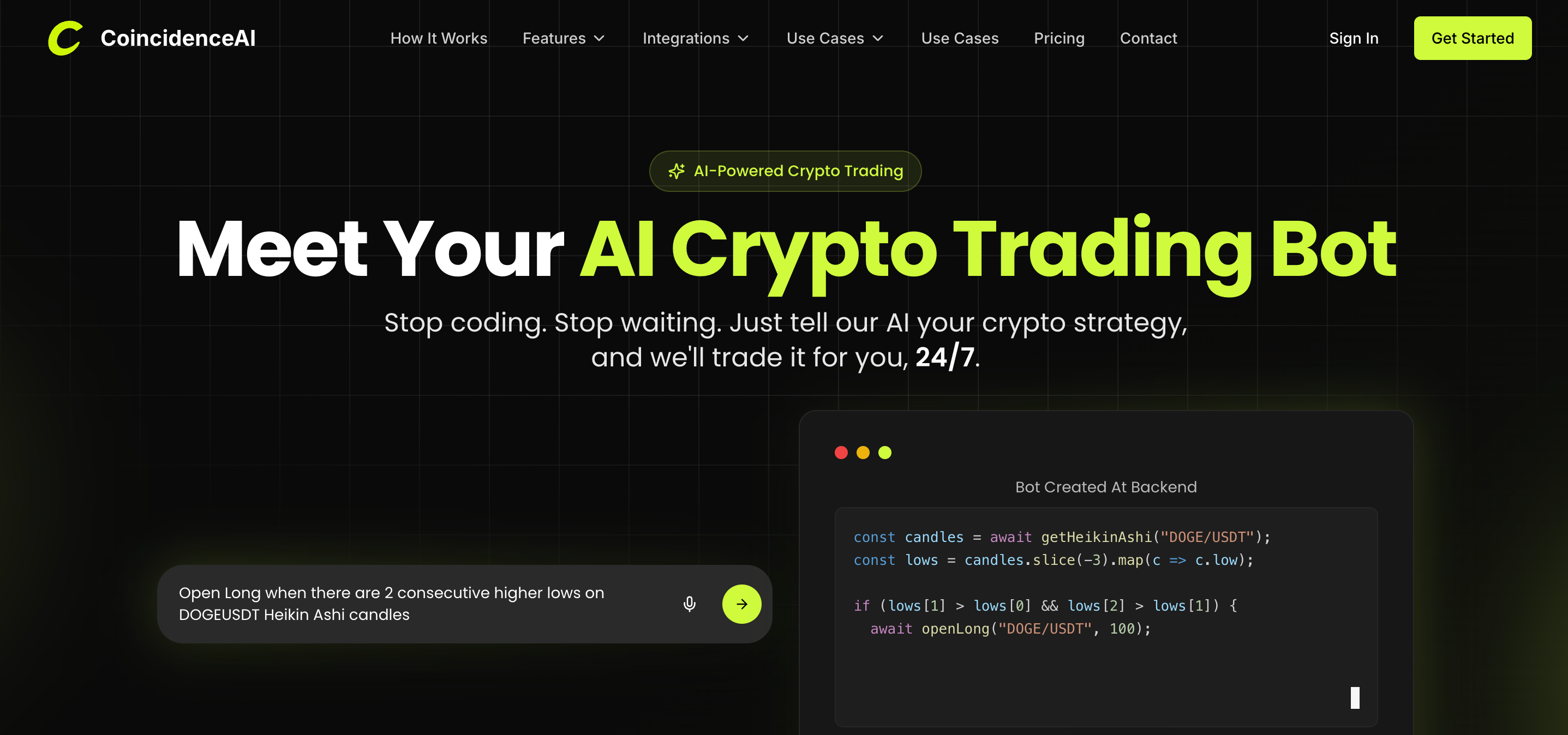
The gap between generating a trading idea and executing it systematically has always required technical infrastructure that most traders lack. Coincidence AI removes that barrier by letting you describe your strategy in plain English, then translating that intent into precise, testable, executable rules.
You think in logic and conditions. The platform handles the technical translation, backtesting, and live deployment.
Turning Intuition Into Explicit Execution Logic
This shift matters because signals typically collapse during implementation. An alert might say "buy when RSI drops below 30," but it doesn't specify what to do if you're already holding three correlated positions, how position size should adjust when volatility spikes, or when the setup becomes invalid.
Those ambiguities destroy consistency. By forcing every concept into explicit logic, you eliminate the guesswork that erodes performance.
From Concept to Validated Strategy
Start with the trading idea itself. You describe the conditions that define a valid trade: entry triggers, exit scenarios, risk constraints, and any filters that determine when the setup applies. "Enter long on Bitcoin when price crosses above the 50-day moving average while RSI is between 40 and 60. Exit at 6% profit or 2.5% loss. Only trade when daily volume exceeds 20 billion."
That description becomes a structured strategy. Coincidence AI converts your plain-language rules into precise parameters that can be measured and tested. No coding required. No syntax errors. Just clear logic translated into executable form.
Decoding the DNA of Strategy Performance
Once defined, you immediately see whether the idea holds up. The platform runs backtests against real historical market data, showing how that exact strategy would have performed across different periods. Not cherry-picked examples or theoretical projections. Actual outcomes: win rate, maximum drawdown, profit factor, and the specific points where the strategy failed.
This historical validation exposes weaknesses before you risk capital. A setup that looks promising on recent charts might have collapsed during 2022's volatility. A filter you thought was conservative might have prevented too many winning trades. The backtesting layer reveals these issues when they're still hypothetical.
Execution Without Emotional Interference
Testing reveals edge. Execution preserves it. Even a statistically sound strategy degrades when applied manually. You hesitate on entries after a losing streak. You exit early when anxiety spikes. You miss trades because you're asleep or distracted when the setup triggers. Fatigue compounds these errors in 24/7 markets.
Coincidence AI addresses this by running validated strategies live on exchanges such as Bybit and KuCoin. The system continuously monitors market conditions, evaluates whether your predefined rules are met, and executes without hesitation or second-guessing. Discipline becomes automatic rather than aspirational.
Why Algorithms are the Ultimate Behavioral Scaffold
This matters more than most realize. One trader described knowing the rules but breaking them when emotions spiked, or P&L turned red. The account wasn't compromised by bad signals. It leaked due to a lapse in discipline under pressure. Automation removes that failure point entirely.
Position sizing adjusts based on your rules, not your mood. If your strategy specifies a 1% risk per trade, the system calculates the position size accordingly, regardless of whether the last three trades were winners or losers. Risk constraints remain consistent. Correlation limits prevent overexposure. The framework you defined during testing gets applied exactly as designed during live trading.
Turning Alerts Into Systems
Consider how a typical signal-style concept evolves within this workflow. "Buy Ethereum when it drops 8% from its 7-day high and the 14-day RSI falls below 35. Exit at 10% profit or 4% loss. Don't trade during the first hour after major economic announcements."
As a standalone alert, that's just an idea someone might act on inconsistently. Within Coincidence AI, it becomes a complete system. You describe those rules in plain language. The platform translates them into precise logic. You review the backtest to assess historical performance across bull, bear, and choppy markets. You refine as needed based on the data. Then you deploy it live, knowing the system will apply those exact rules without deviation.
Shifting From Reactive Trading to Systematic Frameworks
The result is a fundamental shift from reactive trading to deliberate design. Instead of chasing external alerts and hoping they work, you build logic grounded in evidence, test it against reality, and execute it systematically.
The guesswork disappears. The emotional loop breaks. Performance depends on the quality of your framework, not on your ability to override fear or greed in real time.
Closing the Gap Between Language and Logic
Most traders never make this transition because the technical barriers feel insurmountable. Coincidence AI removes those barriers entirely, making systematic trading accessible to anyone who can clearly think through its logic.
But describing a strategy in plain English only works if the translation layer is precise enough to capture what you actually mean.
Trade With Plain English with our AI Crypto Trading Bot
Coincidence AI transforms how you interact with trading logic. Instead of learning programming languages or wrestling with complex configuration interfaces, you describe what you want in normal sentences.
The platform:
- Interprets your intent
- Builds the strategy
- Test it against historical data
- Deploys it live across exchanges
The technical translation happens invisibly, leaving you focused entirely on whether your logic makes sense.
Bridging the Gap Between Simulation and Scale
This accessibility matters because most traders already think in conditional logic without realizing it. "If Bitcoin breaks above $45,000 with volume confirmation, enter long. If it drops below $43,500, exit." That's executable strategy logic expressed naturally.
Coincidence AI captures that reasoning exactly as you articulated it, then applies it consistently without the drift that manual execution introduces. You can finish setup in five minutes and start automating for free, testing whether systematic execution changes your results before committing capital at scale.
Accelerating Logic Through Rapid Iteration
The real shift happens when you stop reacting to external alerts and start refining your own frameworks. Plain-English input enables you to iterate quickly. Test a concept. Review the backtest. Adjust a filter. Test again. The feedback loop tightens from weeks to minutes.
You're no longer dependent on someone else's black box methodology. You're building, validating, and executing your own logic on the same infrastructure that professional funds use, without needing their technical resources or team size.