
The crypto market never sleeps, and neither do the opportunities to make costly mistakes. Without the right trading tools, portfolio-tracking software, and market-analysis platforms, even experienced traders can miss profitable setups or succumb to emotional decisions that drain their accounts. This article reveals the best crypto trading tools that help you execute smarter, safer trades while incorporating essential crypto trading tips to protect your capital and maximize returns.
Coincidence’s AI crypto trading bot removes emotion from your trading decisions and works around the clock to spot opportunities you might miss. Instead of staring at charts for hours or second-guessing your entry points, this automated assistant executes trades based on proven strategies and real-time market data. It manages exchanges, stop losses, and time-zone tracking so you can focus on strategy while it handles execution.
Summary
- According to industry analysis, the average crypto trader can monitor only 2-3 markets simultaneously, creating a structural disadvantage in a space with thousands of tradable assets. When a fourth opportunity appears while you're analyzing the third, it disappears before you can act.
- Emotional decision-making causes 70% of trader failures, according to LinkedIn research from August 2025. The pattern repeats predictably across experience levels: hesitation during valid entries, premature exits driven by anxiety, revenge trading after losses, and position sizing that expands during winning streaks, then contracts after drawdowns.
- Backtesting transforms trading from guesswork into evidence-based decision-making by simulating a strategy's performance on historical data before risking capital. Traders who validate approaches using metrics such as win rate, drawdowns, and consistency across different market conditions gain statistical confidence that gut-feel strategies cannot provide.
- Crypto markets operate 24/7 across all time zones, but manual traders require sleep and cannot monitor activity continuously. Major price moves frequently occur during off-hours when individual traders are offline, with liquidation cascades happening at 3 AM and regulatory announcements dropping on weekends.
- Traders using real-time derivatives data improved timing accuracy by 34% compared to those relying solely on spot price charts, according to CoinDesk research from January 2024. Funding rates reveal when leverage is overextended, open interest shows whether moves have conviction or are just noise, and volume profiles indicate where institutional players accumulated positions.
AI crypto trading bot addresses the gap between having a strategy and consistently executing it by letting traders describe approaches in plain English, then automatically testing them against historical data and deploying them live to exchanges without coding.
Why Most Traders Use the Wrong Tools
The tools traders choose often make trading harder, not easier. The problem isn't a lack of access to information. It's the overwhelming volume of conflicting signals that paralyzes decision-making instead of clarifying it. When every dashboard shows a different story, hesitation replaces confidence.
The Trap of Tool Accumulation
Most traders accumulate tools the same way they accumulate losing positions: by chasing what worked for someone else without understanding why it worked. A momentum indicator designed for trending markets gets applied during consolidation. A professional analytics platform built for institutional desks overwhelms someone who needs clear entry and exit rules.
The Complexity Trap
Adding more indicators rarely improves results. It creates decision fatigue. One metric signals buy while another warns of a reversal. A third suggests waiting. Instead of clarity, you get paralysis.
According to research published by the National Institutes of Health, decision fatigue degrades the quality of choices as the number of decisions increases, leading to slower reactions and more impulsive behavior later. In markets that move in seconds, that hesitation costs money.
The Transition to Live Markets
The pattern repeats across trading communities. Traders report performing well during evaluation phases with simpler rule sets, then struggling when transitioning to live accounts with different parameters. The sudden shift forces overnight adjustments to risk management strategies built over weeks or months.
What worked under one set of constraints collapses under another. The tools didn't change. The rules did. And the trader paid for the lesson.
When Tools Become Obstacles
Most platforms assume deep market knowledge, quantitative skills, and time to interpret dense data streams. They're built for professionals who trade full-time, not individuals balancing jobs or other commitments. Interface complexity creates barriers rather than advantages. Manual workflows compound the issue.
Monitoring charts, scanning news, adjusting orders, and tracking positions across multiple exchanges requires constant attention. Crypto markets operate 24 hours a day, seven days a week. Sustained vigilance becomes impossible.
AI Bots for Conversational Strategy Execution
Platforms like an AI crypto trading bot take a different approach. Instead of requiring traders to learn complex interfaces or coding languages, they let you describe strategies in plain English and execute them automatically while maintaining full custody of your funds. The barrier drops from configuration complexity to conversational clarity, letting you test strategies through paper trading before risking capital.
The Costs of Tool Mismatch in Trading
The consequences of tool mismatch are predictable. Traders miss optimal entries because they weren't watching at the right moment. Exits become emotional instead of rule-based. Subscription costs accumulate across platforms that don't materially improve performance. Despite significant effort, results remain inconsistent.
According to industry research from Bookmap, 90% of traders fail within their first year, often not because they lack information, but because they can't turn information into consistent decisions.
The Real Problem
Tools alone don't create an edge. An edge comes from a clear strategy executed reliably over time. Without that foundation, even advanced software becomes a distraction. The wrong tools don't just fail to help; they can also cause harm. They actively make trading harder by increasing:
- Noise
- Stress
- Inconsistency
They encourage over-leveraging during lenient phases and force conservative adjustments during strict ones. They optimize for platform revenue through repeat purchases and resets, not trader success.
The question isn't whether you have enough tools. It's whether the tools you have actually solve the problems you face. Most don't. They solve problems you don't have while ignoring the ones that cost you money every day.
What Actually Makes a Trading Tool Useful
If most traders struggle not from lack of data but from too much of it, then the best tools are not the ones with the most features. They are the ones that improve decision quality under real market conditions. Effective trading tools reduce uncertainty, speed up action, and enforce discipline.
Clarity Rather Than Complexity
Clean visualizations, simple signals, and intuitive layouts help traders quickly interpret market conditions. Complex dashboards may look powerful, but they often slow down decision-making. Under time pressure, the brain defaults to the clearest input available. Tools that require interpretation can become liabilities when prices move rapidly.
The best interfaces translate market behavior into something immediately actionable. When volatility spikes and you have seconds to decide, the tool that shows you "momentum reversing, high probability pullback zone" beats the one displaying twelve overlapping indicators requiring mental synthesis. Speed of comprehension matters more than depth of data.
Actionable Insights, Not Just Data
Data alone does not produce trades. Traders need conclusions, probabilities, or rules that translate directly into action. "RSI = 62" is data. "Momentum weakening, watch for pullback" is insight. Actionable tools reduce the gap between analysis and execution, helping traders respond decisively rather than hesitate.
This distinction separates useful platforms from sources of information overload. According to research from Obside, 90% of day traders lose money in their first year, often because they can't convert market signals into consistent decisions under pressure. The tool that tells you what the data means performs better than the one that simply displays more of it.
Reliability and Real-Time Accuracy
Outdated or lagging information can be worse than no information at all. Crypto markets move continuously, and price discrepancies of seconds can change trade outcomes. Reliable tools deliver accurate data with minimal latency and consistent uptime. Technical failures during volatile periods can lead to missed opportunities or unintended losses.
Trust breaks when a platform shows stale prices during rapid movement or goes offline during high-volume events. Traders who rely on delayed feeds make decisions based on conditions that no longer exist. The cost isn't just one bad trade. It's the erosion of confidence in your entire decision-making infrastructure.
Automation Capability
Manual execution introduces delays, emotion, and inconsistency. Tools that automate parts of the process, such as alerts, order placement, or rule enforcement, help traders follow their strategy even when attention is divided. Automation is especially valuable in crypto, where markets operate around the clock. A tool that works while you sleep effectively extends your presence in the market.
Most automation platforms assume you know Python or can configure complex logic trees. That barrier keeps many traders stuck in manual workflows even though they understand exactly which rules they want to execute.
Lowering Technical Barriers
Platforms like AI crypto trading bots let you describe strategies in plain English and execute them automatically while maintaining full custody of your funds. The barrier drops from configuration complexity to conversational clarity, letting you test strategies through paper trading before risking capital.
Integration With Execution Platforms
Analysis is only useful if it connects to action. Tools that integrate directly with exchanges or brokers eliminate the need to switch between systems, reducing friction and the risk of errors. Seamless integration allows traders to move from insight to execution within a single workflow, which is critical in fast-moving markets.
Streamlining Trade Execution
Fragmented workflows kill momentum. Spotting an opportunity in one platform, then manually entering orders in another, introduces:
- Lag
- Transcription errors
- Emotional second-guessing
The best tools collapse that distance. When your analysis platform can execute trades directly, you eliminate the pause where doubt creeps in.
Why Simplicity and Usability Matter Under Pressure
Trading compresses decision-making into short time windows, often with financial stakes attached. Cognitive load, stress, and volatility all degrade analytical performance. Simple, intuitive tools preserve mental bandwidth for strategic thinking rather than interface navigation. They also reduce the likelihood of costly mistakes, such as:
- Entering incorrect order sizes
- Misreading signals
In practice, the most valuable trading tools are not the most sophisticated. They are the ones that consistently help you make better decisions faster, especially when markets are least forgiving. The tool that feels invisible during execution, that never makes you pause to remember which button does what, becomes the one you trust when real money is moving.
Related Reading
- Crypto Trading Tips
- Crypto Backtesting
- Dca Bot Vs Grid Bot
- What Is Wash Trading
- Automated Trading Over Manual Trading
- What Is Long And Short In Crypto Trading
- What Is Swing Trading Crypto
- How Does Crypto Leverage Trading Work
- Forex Crypto Trading
Essential Categories of Crypto Trading Tools
Once you know what makes a tool genuinely useful, the landscape becomes easier to navigate. The goal is not to collect random apps but to assemble a functional toolkit where each component solves a specific problem in the trading process. Most effective setups cover five core categories, from analysis to execution and risk control.
Charting and Technical Analysis Platforms
These tools help traders visualize price action and identify patterns, trends, and key levels. Charts translate raw price data into a visual context. Without them, trading becomes guesswork rather than structured decision-making.
What they solve: Understanding market structure. Identifying support and resistance zones. Applying indicators and drawing tools. Timing entries and exits based on visual confirmation rather than gut feeling.
The difference between a good charting platform and a mediocre one shows up in how quickly you can read a chart under pressure. When Bitcoin drops 8% in twenty minutes, you need to see trend breaks, volume spikes, and key levels instantly. Platforms that require five clicks to switch timeframes or bury critical data behind menus slow you down when speed matters most.
Market Data and Analytics Tools
While charts show what price is doing, analytics tools explain why it may be moving. They monitor volume, liquidity, and order flow. They track derivative metrics such as funding rates and open interest. They aggregate news and sentiment. They identify unusual activity or market shifts before they become obvious.
These insights help traders anticipate conditions rather than react blindly. According to research from CoinDesk published in January 2024, traders using real-time derivatives data improved timing accuracy by 34% compared to those relying solely on spot price charts. The difference wasn't intelligence. It was information quality.
Funding rates tell you when leverage is overextended. Open interest reveals whether a move has conviction or is just noise. Volume profiles show where institutional players accumulated positions. This context turns price movements from random chaos into readable behavior.
Risk Management and Portfolio Trackers
Profitability depends as much on loss control as on winning trades. Risk tools provide visibility into exposure across positions and assets. They handle position sizing and capital allocation. They track unrealized and realized profit and loss. They monitor drawdowns. They evaluate performance over time. Without risk oversight, even a good strategy can fail due to:
- Oversized losses
- Overconcentration
The trader who wins seven times but loses everything on the eighth didn't lack skill. They lacked boundaries. Risk tools enforce those boundaries automatically, removing emotion from the equation when positions move against you.
Uncovering Hidden Portfolio Correlations
Most traders think they understand their risk until volatility spikes and they realize three positions are correlated in ways they didn't anticipate. Portfolio trackers surface those connections before they become expensive lessons.
Execution Platforms and Exchanges
Execution tools are where trades actually happen. Speed, reliability, and liquidity matter more here than analytical sophistication. They place market or limit orders. They manage open positions. They access leverage or derivatives. They ensure sufficient liquidity for fills without excessive slippage.
Poor execution can negate strong analysis. Slippage, downtime, or order errors directly impact results. You can identify the perfect entry, but if your exchange goes offline during the setup or your order fills 2% worse than expected, the edge disappears. Execution quality is invisible when it works and catastrophic when it doesn't.
Automation and Algorithmic Tools
Automation addresses the limitations of human attention and discipline. It executes predefined strategies consistently. It monitors markets continuously. It eliminates emotional decision-making. It backtests ideas before risking capital.
This category is increasingly important in crypto due to the market's 24/7 nature. Manual trading cannot cover all opportunities or enforce rules perfectly. The best setups appear at 3 AM. The worst emotional decisions happen after three losing trades in a row. Automation removes both problems.
The Transition From Technical Configuration to Conversational Strategy Execution
Traditional automation platforms assume you know Python or can configure complex logic trees. That barrier keeps many traders stuck in manual workflows even though they understand exactly which rules they want to execute. Platforms like AI crypto trading bot let you describe strategies in plain English and execute them automatically while maintaining full custody of your funds.
The barrier drops from configuration complexity to conversational clarity, letting you test strategies through paper trading before risking capital.
Why Function Matters More Than Brand
Each category corresponds to a stage of the trading workflow. Understand the market. Interpret conditions. Control risk. Execute trades. Maintain consistency. Gaps in any stage create vulnerabilities. Strong analysis without risk control leads to large losses. Good execution without a strategy produces random results. Perfect discipline applied to bad signals just compounds losses faster.
Viewing tools by function helps traders build systems that support performance rather than accumulating features that add complexity without value. The question isn't whether a platform has fifty indicators. It's whether those indicators help you make better decisions or just create more noise to filter.
10 Best Crypto Trading Tools by Use Case
1. Coincidence AI: Strategy Creation, Testing, and Automation Without Coding
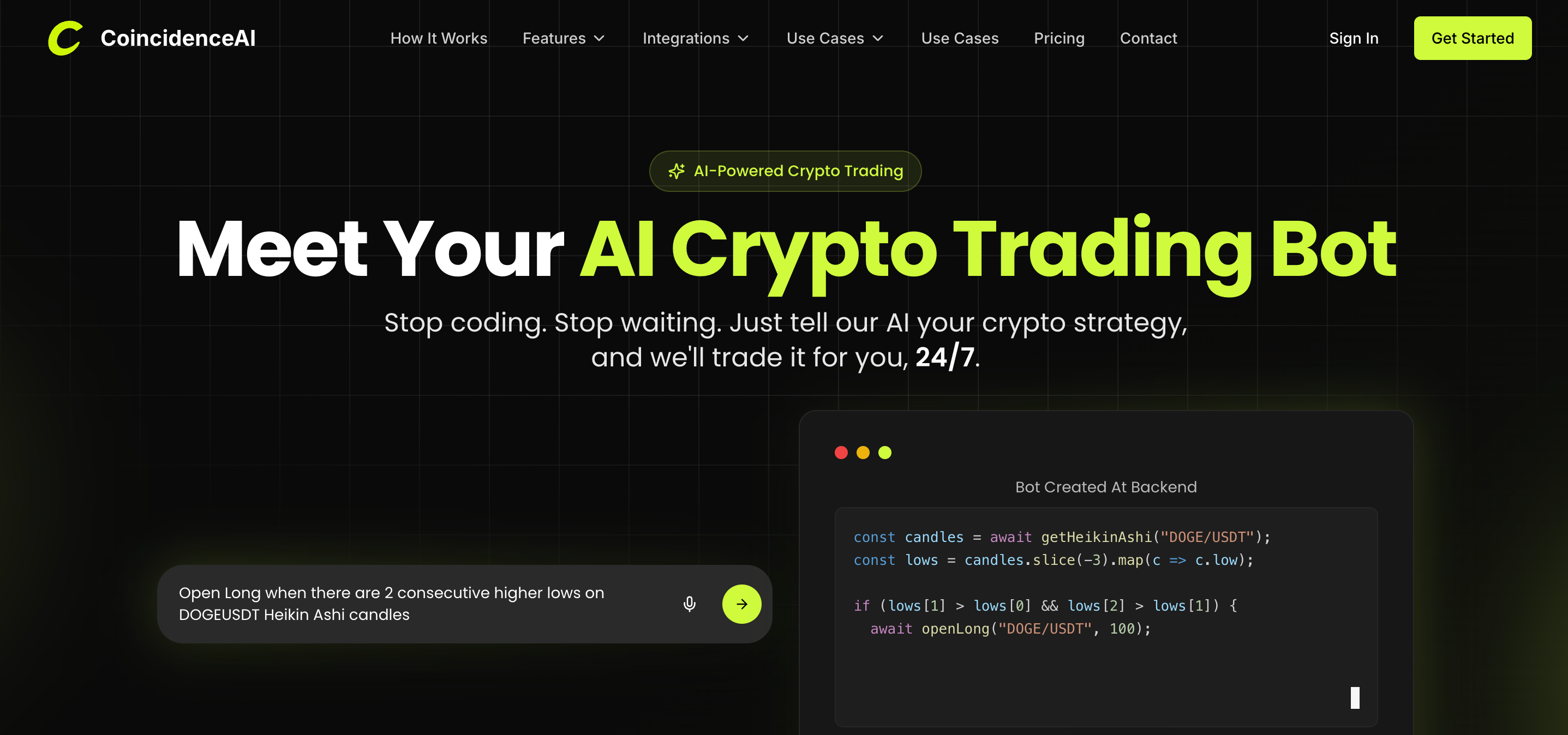
Coincidence AI is built for traders who think in rules and scenarios rather than programming languages. Instead of manually coding strategies or placing trades one by one, you describe your idea in plain English, such as entry conditions, exit logic, or risk parameters, and the platform converts it into a functioning system.
Streamlined Strategy Execution: From Backtesting to Deployment
What makes this powerful is the full pipeline from concept to execution. Strategies can be backtested instantly on real historical data, allowing traders to see how their ideas would have performed before risking capital. Once validated, deployment to exchanges like Bybit and KuCoin can be done with a single action, enabling continuous execution around the clock.
This approach mirrors the capabilities of professional quantitative desks but removes the technical barriers that typically restrict automation to programmers. For traders who want discipline, speed, and consistency, Coincidence AI transforms intuition into a repeatable process that operates even when you are offline.
2. TradingView: Visual Analysis and Market Structure
TradingView remains one of the most widely used charting platforms because it balances depth with usability. Traders can analyze price behavior across multiple timeframes, apply indicators, draw key levels, and test scenarios visually.
The platform supports a broad range of trading styles. Beginners can learn basic support and resistance concepts, while advanced users can build complex indicator combinations or custom scripts. Its clean interface allows rapid interpretation of market conditions, which is critical during volatile periods.
Social features also play a role. Public ideas and shared analyses expose traders to alternative viewpoints, helping them refine their own strategies.
3. CoinMarketCap or CoinGecko: Market Discovery and Macro Overview
Before analyzing individual charts, traders often need a broad view of the crypto ecosystem. Market aggregators such as CoinMarketCap and CoinGecko provide this perspective by tracking thousands of assets across exchanges.
These platforms help identify where capital is flowing, which sectors are gaining attention, and how major assets are performing relative to the rest of the market. Metrics such as market capitalization, trading volume, and historical performance help traders quickly filter opportunities.
For newcomers, they serve as a map of the crypto landscape. For experienced traders, they help detect emerging trends before they appear on individual charts.
4. Coinglass: Derivatives Data and Market Sentiment
Derivative markets often drive short-term price movements in crypto. Coinglass aggregates critical data, including funding rates, liquidations, open interest, and long-versus-short positioning, across major exchanges.
These metrics reveal how leveraged traders are positioned and where forced buying or selling might occur. For example, clusters of liquidation levels can signal areas where volatility may spike if the price moves sharply. By understanding sentiment and leverage, traders gain context that pure price charts cannot provide.
5. Exchange Platforms: Execution and Liquidity Access
Exchanges such as Bybit and KuCoin are where trades actually occur. They provide order books, liquidity pools, leverage options, and account management tools necessary for entering and exiting positions.
The Impact of Execution Quality on Trading Profitability
Execution quality directly affects profitability. Features such as advanced order types, rapid matching engines, and stable infrastructure ensure trades are filled as intended, even during fast-moving markets. For active traders, familiarity with exchange interfaces is essential because speed and precision matter as much as analysis.
6. Portfolio Trackers: Risk and Performance Oversight
As traders diversify across assets or accounts, tracking exposure becomes increasingly complex. Portfolio management tools consolidate holdings into a single view, showing allocation, profit and loss, and performance over time. This visibility helps traders manage risk more effectively.
The Importance of Portfolio Tracking
Overexposure to one asset or sector becomes immediately apparent, enabling adjustments before losses compound. Portfolio tracking also supports long-term evaluation. Understanding which strategies or assets contribute most to performance allows more informed capital allocation decisions.
7. News Aggregators: Fundamental Context
Crypto markets react quickly to regulatory announcements, exchange developments, macroeconomic events, and technological breakthroughs. News aggregation tools compile relevant information from multiple sources, reducing the need to monitor dozens of outlets individually.
Timely awareness of major events can prevent traders from being blindsided by sudden volatility. It also provides context for price movements that might otherwise appear random.
For traders combining technical and fundamental approaches, this category is indispensable.
8. Order Flow and Liquidity Analysis Tools: Microstructure Insight
Order flow tools analyze real-time buying and selling activity within the order book. They reveal where large participants are placing orders and how liquidity is distributed.
This information helps traders refine entries and exits with greater precision. Instead of reacting only to price changes, they can anticipate moves based on shifts in supply and demand at specific levels. Such tools are particularly valuable for short-term strategies where small price differences can significantly affect outcomes.
9. Alert Systems: Opportunity Monitoring Without Constant Screen Time
Crypto markets operate continuously, making it impossible for most individuals to monitor charts around the clock. Alert tools address this by notifying traders when predefined conditions occur, such as:
- When the price reaches a key level
- An indicator crosses a threshold
This allows traders to remain responsive without sacrificing productivity or sleep. Alerts effectively act as a monitoring assistant, ensuring important setups are not missed. For part-time traders, alerts can dramatically increase participation in opportunities without increasing time commitment.
10. Backtesting Platforms: Strategy Validation
Backtesting tools simulate how a trading strategy would have performed using historical data. This process helps identify strengths, weaknesses, and potential risks before real money is involved.
By analyzing metrics such as win rate, drawdowns, and consistency across market conditions, traders gain statistical confidence in their approach. Backtesting transforms trading from guesswork into evidence-based decision-making. When combined with forward testing and disciplined execution, validated strategies provide a foundation for long-term performance.
Why Matching Tools to Use Case Matters
Each category addresses a different stage of the trading process:
- Discovering opportunities
- Analyzing conditions
- Managing risk
- Executing trades
- Maintaining consistency
The most effective traders assemble tools that work together as a system rather than relying on any single platform. When tools align with your strategy and workflow, they amplify your skill rather than add noise.
Related Reading
- What Is OTC Trading Crypto
- What Are Crypto Trading Signals
- Most Profitable Crypto Trading Strategy
- Best App For Crypto Day Trading
- Best Crypto to Day Trade
- Best Crypto Copy Trading Platform
- Crypto Futures Trading for Beginners
- Crypto Day Trading Strategies
- Best Crypto Trading Platform
- Advanced Crypto Trading Strategies
Why Manual Trading Still Limits Performance

Manual trading creates a performance ceiling that discipline alone cannot break. The constraint isn't knowledge or effort. It's the fundamental mismatch between human capacity and market structure. Crypto operates continuously across time zones without pause, while human attention requires:
- Sleep
- Focus
- Recovery
The Cognitive Limits of Manual Trading
According to Adventures of Greg, manual traders can only monitor a limited number of markets simultaneously, typically 2-3 at most. When opportunity appears in a fourth market while you're analyzing the third, it's already gone by the time you notice. The bottleneck isn't screen size or chart layout. It's cognitive bandwidth under time pressure.
The 24/7 Problem
Bitcoin doesn't respect your sleep schedule. Major price moves frequently occur during Asian trading hours when U.S. traders are offline. Liquidation cascades happen at 3 AM. Regulatory announcements drop on weekends. The trader who needs eight hours of sleep each night is systematically excluded from roughly one-third of all market activity.
Setting alerts helps, but waking up to a notification means you're already reacting to conditions that have evolved. By the time you're alert enough to analyze the context and place orders, the setup that triggered your alarm may already have resolved. You didn't miss the opportunity because you were slow. You missed it because you were human.
Emotional Interference
Fear and greed don't disappear with experience. They adapt. The veteran trader who confidently takes losses during calm markets can still freeze when volatility spikes and three positions move against them simultaneously. The brain's threat response doesn't distinguish between financial loss and physical danger. Under stress, decision-making degrades predictably.
The Emotional Pitfalls of Trading
LinkedIn research from August 2025 found that 70% of traders fail due to emotional decision-making. The pattern repeats:
- Hesitation during valid entries
- Premature exits driven by anxiety
- Revenge trading after losses
- Position sizing that expands during winning streaks and contracts after drawdowns
These aren't character flaws. They're predictable responses to uncertainty and risk.
Execution Inconsistency
Writing down rules is easy. Following them perfectly across hundreds of trades is nearly impossible. Fatigue accumulates. Distractions interrupt focus. A phone call during a critical moment changes the outcome. The manual trader who executes their strategy flawlessly for two weeks can still deviate during week three when personal stress or market volatility increases.
Small inconsistencies compound. Taking one trade outside your criteria seems harmless until it becomes a pattern. Adjusting stop losses "just this once" erodes the statistical foundation on which your strategy depends. The edge you validated through backtesting assumes perfect execution. Manual trading introduces variance that slowly degrades that edge.
Opportunity Cost During Downtime
Every hour spent away from screens is an hour where your strategy isn't active. If your approach generates positive expected value, then time offline directly reduces total returns. A trader working a full-time job can only participate in the evenings and on weekends, missing the majority of market hours when their edge is active.
This isn't about working harder. It's about structural limitations. You cannot scale attention the way you can scale capital. Adding more money to your account doesn't help if you're still limited to the same number of hours and the same cognitive capacity.
Why Backtesting Stays Theoretical
Manual backtesting requires scrolling through:
- Historical charts
- Identifying setups
- Recording hypothetical entries and exits
- Calculating results
The process is slow and vulnerable to bias. Traders unconsciously remember successful patterns more vividly than failures. They might skip over periods that don't fit their narrative or interpret ambiguous setups in their favor.
Even rigorous manual testing can't replicate the psychological pressure of live execution. Seeing a setup on a static chart feels different from watching it develop in real time with your capital at risk. The confidence gained from manual backtesting often evaporates during the first string of live losses.
The Role of Conversational AI in Ensuring Strategy Consistency and Execution
Most traders describe their strategy clearly, but execute it inconsistently. The familiar pattern appears: strong performance during evaluation phases with simple rules, then degradation when transitioning to live markets with different risk parameters. Manual execution introduces the gap between knowing what to do and doing it every single time.
Platforms like AI crypto trading bots address this by letting traders describe strategies conversationally and execute them automatically while maintaining full custody. The barrier drops from configuration complexity to conversational clarity.
Backtesting happens instantly on real historical data, and deployment to exchanges occurs without manual order placement. The strategy runs continuously, applying the same logic at 3 AM as it does at 3 PM.
The Consistency Gap
The difference between profitable and unprofitable trading often isn't strategy quality. It's execution consistency. A mediocre approach applied perfectly outperforms a sophisticated one applied sporadically. Manual trading guarantees inconsistency because humans are inherently inconsistent.
Attention drifts. Energy fluctuates. Emotions interfere. These aren't problems to solve through more discipline. There are inherent limitations of manual processes in environments that demand perfect repetition.
How Coincidence AI Turns Ideas Into Live Strategies
The gap between having a trading idea and executing it consistently isn't knowledge. It's a translation. You understand when to enter based on momentum shifts and volume confirmation. You know your exit rules. You've defined your risk limits. But converting that mental model into action every single time, without hesitation or deviation, requires infrastructure most traders don't have.
Coincidence AI solves the translation problem. You describe your strategy in conversational language. The system interprets those instructions and builds executable logic. No scripting. No syntax errors. No wrestling with conditional statements or trying to remember which bracket closes which function.
From Description to Deployment
The interface accepts plain English. "Enter long when RSI crosses above 30 and volume exceeds the 20-period average. Exit when price hits 3% profit or 1.5% loss." That sentence becomes a functioning strategy without intermediate steps. The platform:
- Parses intent
- Maps conditions to market data
- Automatically constructs the decision tree
This matters because the barrier for most traders isn't understanding what they want to do. It's implementing it.
According to Clari's 2025 research, 95% of revenue leaders say AI is critical to their 2025 strategy, reflecting a broader shift toward systems that execute plans rather than just analyze them. Trading faces the same evolution. Ideas without execution infrastructure remain hypothetical.
The Power of Instant Backtesting
Before risking capital, you validate. Instant backtesting runs your strategy against historical price data, showing exactly how it would have performed across past volatility spikes, trending periods, and sideways consolidation. You see win rate, drawdown, and consistency. Weaknesses surface immediately.
Maybe your exit logic triggers too early during strong trends. Maybe your entry conditions produce too many false signals during low-volume periods. You refine the rules, test again, and iterate until the results justify confidence.
Continuous Execution Without Supervision
Once validated, deployment takes one action. The strategy goes live on exchanges like Bybit and KuCoin. Orders execute automatically when conditions match your rules. No manual monitoring. No middle-of-the-night alerts forcing you awake to place trades. The system operates continuously, applying identical logic whether you're:
- Asleep
- Working
- Focused elsewhere
This addresses crypto's fundamental challenge: markets that never close, meeting human attention that must. The opportunity that appears at 2 AM gets captured with the same discipline as the one at 2 PM. Emotional interference disappears because emotions aren't part of the execution path.
The strategy doesn't hesitate after three consecutive losses or overtrade after three consecutive wins.
Accessibility Without Compromise
Professional trading desks employ quantitative analysts who code strategies in Python or C++. They maintain server infrastructure. They handle data feeds and API integrations. That setup requires technical expertise and resources that most individual traders lack.
Coincidence AI delivers equivalent automation capability through conversational input. The complexity exists, but it's hidden behind an interface anyone can use.
The Democratization of Strategy
The shift isn't just convenience. It's the democratization of tools previously gated by technical skill. You don't need to learn a programming language to test whether your momentum strategy actually works. You don't need to hire a developer to automate execution. The barrier drops from months of learning to minutes of describing.
From Reactive to Systematic
Manual trading operates in reaction mode. Price moves, you respond. Volatility spikes, you scramble. A setup appears while you're in a meeting, and you miss it. Automation inverts that relationship.
The strategy monitors continuously and acts when conditions align. You shift from chasing opportunities to systematically capturing them. The result isn't just saved time; it's transformed consistency.
Every trade follows the same logic. Every risk parameter gets enforced identically. The gap between your intended strategy and your actual execution collapses to zero. What you designed runs every single time, without degrading from fatigue or emotion.
Related Reading
- Best Crypto Prop Trading Firms
- Best Crypto Leverage Trading Platform USA
- Best Crypto Options Trading Platform
- Best Crypto Paper Trading
- Best Crypto Trading Simulator
- Coinrule Alternative
- Cryptohopper vs 3Commas
- HaasOnline vs 3Commas
Trade With Plain English With Our AI Crypto Trading Bot
If you have trading ideas but struggle to test or execute them consistently, describe your strategy in plain English inside Coincidence AI, run an instant backtest, and deploy it live to your exchange in minutes. Turn intuition into a disciplined system without writing a single line of code.
The Conversational Approach
The barrier isn't your understanding of markets. It's the translation layer between what you know works and what actually runs while you're offline. When you can articulate your entry logic, your exit conditions, and your risk limits conversationally, the infrastructure handles everything else. Testing happens against real historical data.
Precision Trading on Bybit and KuCoin
Deployment connects directly to Bybit and KuCoin. Execution follows your rules precisely, whether it's Tuesday afternoon or Saturday at 3 AM. The strategy you described is the strategy that trades, with full custody of your funds maintained throughout. No compromise between accessibility and control.