
The cryptocurrency market never sleeps, and neither does the pressure to make profitable trading decisions. For many investors, one of the most valuable crypto trading tips is recognizing when to leverage successful traders' expertise rather than going it alone. This article explores the best crypto copy trading platforms that allow you to mirror the strategies of proven performers, helping you work toward consistent returns without spending countless hours analyzing charts and market trends.
Coincidence’s AI crypto trading bot offers an intelligent approach to automated crypto trading, enabling you to benefit from sophisticated trading strategies while maintaining control over your investment decisions. This tool helps bridge the gap between manual trading and fully automated systems, giving you access to the kind of performance tracking and portfolio management features that serious traders rely on for steady growth in volatile markets.
Summary
- Retail crypto traders face brutal odds, with regulatory data showing that 70-80% of accounts trading leveraged instruments lose money according to ESMA consumer warnings. The behavioral factors driving these losses (overtrading, poor risk control, emotional decision-making) remain constant regardless of whether someone trades stocks, forex, or cryptocurrency.
- Copy trading platforms promise a shortcut by automatically replicating successful traders' positions, yet 95% of copy traders still fail according to SMARTT's analysis. The disconnect stems from execution timing differences, fee structures, and account-size variations that platforms rarely explain up front.
- Performance decay accelerates as successful strategies attract capital and follower counts grow. When thousands of accounts mirror the same trades simultaneously, order-book liquidity is quickly absorbed, pushing entry prices away from optimal levels. The lead trader entering with $50,000 might fill at $1.00, while late followers totaling $10 million in replicated orders get filled at $1.03 or worse.
- Followers inherit complete risk profiles without understanding the decision logic behind trades. A trader generating 80% returns might achieve those gains through concentrated bets on three altcoins using 5x leverage while holding through 30% drawdowns. The leaderboard displays the gain but conceals the process, leaving followers unable to assess whether the returns came from a sustainable methodology or from favorable conditions that won't repeat.
- Latency and slippage create material execution differences even when trades are copied within seconds. Empirical studies show slippage increases sharply during volatile periods as liquidity evaporates, and in crypto markets where prices move several percent within minutes, followers entering moments later receive substantially worse fills.
AI crypto trading bots address these structural issues by allowing traders to define strategy parameters in plain language, backtest them on historical data, and deploy automated execution across multiple exchanges without relying on another person's real-time judgment or risk tolerance.
Most Retail Traders Lose: Copy Trading Promises a Shortcut

The promise of copy trading is seductive: skip the years of painful learning and simply mirror the positions of someone who's already figured it out. For most people entering crypto markets, this sounds like the rational choice. Why struggle through losses and confusion when you can automate success by following proven performers?
The struggle is real. Charts never stop moving. Narratives shift hourly. A strategy that worked yesterday can fail spectacularly today. Despite watching videos, studying indicators, and obsessively monitoring positions, consistent profitability feels impossibly distant.
The Retail Trading Reality
The scale of the challenge shows up in regulatory data. According to [ESMA's consumer warnings on leveraged products, around 70–80% of retail trading accounts lose money when trading leveraged instruments. While crypto markets operate differently from traditional CFDs, the behavioral factors remain identical:
- Overtrading
- Poor risk control
- Emotional decision-making
The asset class changes. Human psychology doesn't.
The Learning Curve Nobody Warns You About
Successful trading requires mastery of market structure, risk management, position sizing, and psychological discipline. These skills develop over years, not weeks. Most beginners underestimate the amount of experience needed to perform consistently in a high-volatility environment. The gap between knowing what to do and executing it under pressure is where most accounts die.
Emotion undermines results faster than ignorance. Fear causes premature exits from winning trades. Greed or frustration leads to oversized positions and impulsive entries. Losses trigger attempts to "win it back," compounding risk rather than reducing it. The cycle repeats until capital evaporates.
The Hidden Cost of Information Overload on Trading Consistency
Information overload adds another layer of difficulty. Social media feeds, news alerts, technical analyses, and conflicting opinions create noise rather than clarity. Without a coherent framework, traders switch strategies frequently, preventing any single approach from proving itself over time. The constant search for the "right" method becomes the problem itself.
Why Copy Trading Feels Like the Answer
Against this backdrop, copy trading appears to offer a compelling shortcut. Instead of developing expertise independently, users can mirror the trades of someone with a strong track record. The model promises a plug-and-play path to performance:
- Select a successful trader
- Allocate capital
- Let the system replicate its decisions automatically
Execution and Performance Gaps
Appeal reinforces a common belief: that copying a profitable trader will produce identical results. In reality, outcomes can diverge due to differences in:
- Timing
- Slippage
- Risk tolerance
- Market conditions
SMARTT's analysis of copy trading failures found that 95% of copy traders fail, often because they misunderstand how replication actually works beneath the surface.
The frustration shows up in trader communities constantly. People watch their copied positions lose money while the original trader's account stays green. The confusion is real: same trades, different outcomes. The disconnect stems from differences in execution timing, fee structures, and account sizes that platforms rarely explain upfront.
Tools like Coincidence’s AI trading bot approach automation differently by using AI-driven strategies across multiple exchanges rather than simply mirroring individual traders. This shifts the focus from copying human decisions to leveraging algorithmic analysis that adapts to market conditions in real time, addressing some of the timing and execution gaps that plague traditional copy trading models.
The Gap Between Promise and Performance
The core assumption behind copy trading is that replicating trades equals replicating results. This logic breaks down when you examine how trades actually execute. A trader with a large account might enter a position gradually, while your smaller account gets filled at a single, less favorable price. Slippage compounds. Fees accumulate. The math stops working.
The Failure of Strategy Alignment and Recognition Lag in Copy Trading
Risk tolerance creates another divergence. The trader you're copying might hold through a 30% drawdown because their strategy requires it. But if that drawdown exceeds your psychological or financial capacity, you'll exit early, locking in losses the original trader will eventually recover from. The strategy didn't fail. Your alignment with it did.
Market conditions shift constantly. A trader who performed well in a trending market might struggle in choppy, range-bound conditions. By the time you notice the performance degradation and switch to a different trader, you've already absorbed the losses. The lag between recognition and action costs you capital and confidence.
Related Reading
- Crypto Trading Tips
- Crypto Backtesting
- Dca Bot Vs Grid Bot
- What Is Wash Trading
- Automated Trading Over Manual Trading
- What Is Long And Short In Crypto Trading
- What Is Swing Trading Crypto
- How Does Crypto Leverage Trading Work
- Forex Crypto Trading
What is Crypto Copy Trading?

Crypto copy trading links your account to another trader's activity and automatically replicates their positions. When they buy, you buy. When they sell, you sell. The execution happens through platform infrastructure without requiring you to monitor charts or make independent decisions.
Proportional Scaling Logic
The system scales trades proportionally based on account size. If the lead trader commits 10% of their capital to a position, your account allocates roughly 10% of yours. This proportional logic allows smaller accounts to mirror the same strategy without needing identical balances. The automation removes discretion entirely. Unlike signal services that send alerts you can choose to follow or ignore, copy trading executes immediately. The trade happens whether you're watching or not.
How the Replication Mechanism Actually Works
Most platforms use API connections to monitor the lead trader's account and trigger corresponding actions in follower accounts. When the lead trader opens a long position on Bitcoin, the system calculates the equivalent position size for your account and executes it within seconds. The same process applies to:
- Stop losses
- Take profits
- Position exits
This infrastructure operates across spot and derivatives markets. Some traders focus on simple buy-and-hold strategies in spot markets. Others use leveraged futures or perpetual contracts, amplifying both gains and losses.
The platform replicates whichever instruments the lead trader uses, meaning followers can end up in complex leveraged positions without fully understanding the risk profile.
Metrics and Performance Bias
Platforms typically offer leaderboards displaying performance metrics, such as:
- Historical returns
- Maximum drawdowns
- Win rates
- Number of followers
- Sometimes risk scores
These statistics help users filter through hundreds or thousands of potential traders to copy. The data looks objective, but it often emphasizes recent performance over long-term consistency. A trader who caught one strong trend might rank highly despite lacking a proven strategy across different market conditions.
The Difference Between Copy Trading and Signal Following
Manual signal services send trade alerts through Telegram, Discord, or email. You receive a notification that a trader entered a position, then decide whether to replicate it, adjust the size, or ignore it entirely. Execution remains under your control. Timing depends on how quickly you see the alert and place the order.
Instant Mirror Execution
Copy trading removes that layer of decision-making. The trade executes automatically based on pre-set parameters. You don't receive an alert asking for confirmation. The position appears in your account because the system detected activity in the lead trader's account and mirrored it instantly.
Speed can be an advantage in fast-moving markets, but it also means you can't filter out trades that don't align with your current risk tolerance or market view.
Passive Strategy Conversion
The distinction matters because it changes your role entirely. Signal following keeps you as an active participant who evaluates each trade. Copy trading converts you into a passive recipient of someone else's strategy. That shift in control has consequences when market conditions change or when the lead trader's approach no longer fits your objectives.
Why Proportional Sizing Doesn't Always Work as Expected
The promise of proportional sizing sounds elegant: your $1,000 account mirrors the same percentage allocations as a $100,000 account. In theory, this creates identical risk exposure relative to account size. In practice, execution differences create divergence.
Larger accounts often get better fill prices due to order size and priority. A lead trader might enter a position gradually across multiple price levels, averaging into a favorable entry. Your smaller account is filled at a single price point, often at a less favorable rate. Slippage compounds this effect during volatile periods when prices move quickly between order placement and execution.
The positive return figure also doesn't account for opportunity cost or whether those returns exceeded what a simple buy-and-hold strategy would have delivered during the same period.
The Control You Surrender
Copying a trader means accepting their entire approach:
- Entry timing
- Position sizing
- Stop loss placement
- Exit strategy
You inherit their risk tolerance, whether or not it matches yours. A trader comfortable holding through a 40% drawdown might execute a strategy that works over months but can psychologically destroy your account within weeks.
The Market Regime Lag
Market conditions shift constantly. A trader who excels in trending markets might struggle when volatility drops and price action turns choppy. By the time you recognize the performance degradation and decide to stop copying, you've already absorbed weeks of losses. The lag between market regime change and your reaction creates unavoidable damage.
The Limitation of Leaderboard Metrics and the Shift Toward Algorithmic Adaptability
Some traders adapt their strategies as conditions evolve. Others stick rigidly to a single approach regardless of market structure. You won't know which type you're copying until you've already committed capital. The leaderboard metrics don't reveal adaptability or decision-making
process. They show results, not reasoning.
Platforms like Coincidence’s AI trading bot approach automation differently by using AI-driven strategies that analyze market conditions across multiple exchanges rather than mirroring individual human traders. This shifts the dependency from one person's judgment to algorithmic analysis that adjusts to real-time data patterns, addressing some of the rigidity and lag issues inherent in traditional copy-trading models.
What the Leaderboards Don't Tell You
Performance rankings create an illusion of objectivity. A trader with a 150% return over three months ranks higher than one with a 40% return over two years. The system rewards recent performance and dramatic gains, not consistency or risk-adjusted returns. Short-term luck looks identical to long-term skill in a leaderboard snapshot.
Maximum drawdown figures reveal how much an account declined from peak to trough, but they don't show how long the drawdown lasted or how many times it occurred. A trader might:
- Have one deep drawdown followed by steady gains
- Experience repeated smaller drawdowns that compound into psychological exhaustion for followers.
The metric alone doesn't distinguish between these scenarios.
The Statistical Mirage of Win Rates and Social Proof in Trading
Win rate percentages mislead without context. A 70% win rate sounds impressive until you realize the average winning trade gains 2% while the average losing trade drops 8%. The math doesn't work. High win rates often correlate with strategies that cut winners early and let losers run, the opposite of what profitable trading requires.
The number of followers creates social proof, but it doesn't validate the quality of the strategy. A trader might attract thousands of followers through aggressive marketing or one viral trade, then deliver mediocre results for months afterward. The follower count reflects popularity, not performance sustainability.
What Makes a Copy Trading Platform “Best”

A strong copy trading platform isn't defined by the trader with the highest return on its leaderboard. It's built on transparent performance data, granular risk controls, reliable execution infrastructure, and security that doesn't collapse under pressure. The difference between a platform worth using and one that quietly erodes capital lies in how it handles the unglamorous details:
- Slippage management
- Drawdown visibility
- Allocation limits
- What happens when volatility spikes at 3 a.m.
Verified Performance Data Over Self-Reported Wins
Audited track records separate real performance from marketing narratives. Platforms that distinguish between verified results and self-reported figures reduce the risk of following traders who inflate their history or selectively display winning periods. Metrics such as consistency across multiple market cycles, trade-by-trade history, and risk-adjusted returns provide context that a single percentage gain never will.
Granular Performance Forensics
Historical data should show more than cumulative profit. You need visibility into how returns were generated:
- Position sizes
- Leverage used
- Frequency of trades
- Whether gains came from a handful of lucky bets or systematic execution
A trader who made 200% in three months through one leveraged altcoin position carries a different risk than one who built 40% returns across 150 trades with controlled exposure.
Infrastructure-Level Transparency
Platforms that hide granular data behind vague summaries make it impossible to make informed decisions. If you can't see individual trade entries, exits, and the conditions under which they occurred, you're copying blind. The best platforms treat transparency as infrastructure, not a feature you unlock at higher subscription tiers.
Risk Controls That Actually Limit Damage
Allocation caps and automatic stop conditions determine whether a bad streak becomes a recoverable loss or a catastrophic one. Users should be able to set a maximum capital limit for any single trader, define drawdown thresholds that trigger automatic disconnection, or pause copying when specific conditions are met. Without these safeguards, followers inherit risks that exceed their tolerance, often discovering the mismatch only after significant damage.
The Importance of Granular Risk Controls and Adaptive AI Management
A trader comfortable with 50% drawdowns might execute a strategy that works beautifully over two years but destroys your account in six weeks. If the platform doesn't let you cap exposure or exit automatically when losses hit a predefined level, you're stuck riding out volatility that doesn't match your financial reality.
The controls need to be granular, not binary. "Stop copying this trader" is too blunt. "Stop if drawdown exceeds 15% or if three consecutive losing days occur" gives you precision.
Traditional copy trading locks you into someone else's risk appetite. Platforms like Coincidence’s AI trading bot shift the model by using AI-driven strategies that analyze real-time market conditions across multiple exchanges, enabling adaptive risk management rather than rigidly replicating a single trader's decisions.
Execution Quality and Slippage Management
Identical trades don't produce identical results when execution differs. Latency, liquidity constraints, and order routing determine whether your entry price matches the lead trader's or arrives several percentage points worse. In fast-moving crypto markets, a two-second delay between the lead trader's execution and your replication can mean the difference between profit and loss on a volatile altcoin.
Platforms with direct exchange integrations and low-latency infrastructure reduce the gap between signal and execution. Those relying on slower API polling or manual order placement introduce friction that compounds over hundreds of trades. Slippage might seem negligible on a single position, but across dozens of trades per month, it erodes returns faster than most fee structures.
The Market Depth Disconnect
Fill quality also varies by account size. A lead trader with $500,000 might scale into a position across multiple price levels, achieving a favorable average entry. Your $5,000 account gets filled at a single price point, often the least favorable one available during that execution window. The proportional sizing promise breaks down when market depth can't accommodate simultaneous orders at the same price.
Transparency Around Strategy and Drawdowns
Understanding what you're copying matters as much as knowing it worked in the past. A trader who achieved 180% returns through aggressive leverage on low-cap altcoins will experience equally dramatic losses when sentiment reverses. Platforms that display maximum historical drawdowns, volatility metrics, average holding periods, and position concentration allow users to assess whether a strategy aligns with their risk capacity.
The Recovery Window Reality
Drawdown duration matters more than depth alone. A quick 40% loss recovered in a month is less taxing than six months underwater, which often forces followers to exit early, locking in losses the trader later recovers.
Win rate without context misleads. A 75% win rate sounds impressive until you realize the average winner gains 3% while the average loser drops 12%. The math guarantees long-term failure despite frequent small wins.
Platforms that show profit factors, average risk-reward ratios, and trade distributions help users distinguish between sustainable strategies and those likely to collapse during the next volatility spike.
Security and Infrastructure Reliability
Funds remain on the platform or connected exchange, making robust safeguards against:
- Technical failures
- Outages
- Unauthorized access essential
Downtime during major market moves can be catastrophic for automated strategies. A platform that goes offline during a flash crash leaves copied positions exposed and unable to exit, turning manageable losses into account-ending disasters.
Hierarchical Access Controls
Two-factor authentication, withdrawal whitelisting, and API key permissions with restricted access reduce the risk of unauthorized trading or fund transfers. Platforms that allow API keys with full withdrawal permissions create unnecessary vulnerability. The best services enforce read-only or trade-only API configurations, ensuring that even if credentials are compromised, funds can't be moved off the exchange.
Operational Credibility Standards
Cold storage for platform-held funds, regular security audits, and transparent incident response protocols signal whether a platform treats security as infrastructure or an afterthought. Services that have never published security practices or experienced unexplained outages without clear communication should raise immediate concern.
In an industry where exit scams and technical failures are common, operational transparency becomes a filter for credibility.
Related Reading
- What Is OTC Trading Crypto
- What Are Crypto Trading Signals
- Most Profitable Crypto Trading Strategy
- Best App For Crypto Day Trading
- Best Crypto to Day Trade
- Best Crypto Trading Tools
- Crypto Futures Trading for Beginners
- Crypto Day Trading Strategies
- Best Crypto Trading Platform
- Advanced Crypto Trading Strategies
10 Popular Crypto Copy Trading Platforms (By Use Case)
1. eToro
eToro built its reputation on social integration, treating trading as a community activity rather than isolated decision-making. The interface prioritizes simplicity, with visual portfolio displays and one-click copying. Users can follow diversified portfolios rather than chasing individual high-return traders, thereby reducing concentration risk.
Asset Liquidity Trade-offs
The trade-off appears in asset selection. Crypto offerings remain narrower than those of dedicated exchanges, and spreads often run higher than those of pure trading venues. For someone taking their first steps into automated replication, the friction cost of wider spreads might be acceptable in exchange for reduced complexity.
For active traders executing dozens of positions monthly, those spreads compound into a significant drag on performance.
2. Bitget Copy Trading
Bitget emphasizes curation over breadth. Trader rankings appear prominently, and allocation controls stay straightforward. The platform attracts newcomers seeking exposure to derivatives strategies without directly managing margin requirements or liquidation mechanics. The risk lies in dependency.
Lead traders operate with varying levels of risk management discipline, and followers inherit those practices, whether they understand them or not. A trader comfortable using 10x leverage might execute a strategy that works beautifully until volatility spikes, at which point follower accounts experience liquidations they never anticipated.
3. Bybit Copy Trading
Bybit targets users already familiar with perpetual futures and leveraged instruments. Deep liquidity and a large pool of professional-style traders create opportunities for sophisticated strategies. Potential returns scale higher than spot-only platforms, but leverage amplifies downside just as aggressively.
Performance can deteriorate rapidly during volatility spikes, and the platform assumes users understand:
- Margin mechanics
- Funding rates
- Liquidation thresholds
If those concepts feel unfamiliar, copying leveraged traders becomes a fast path to account destruction.
4. OKX Copy Trading
OKX integrates copy functionality within a comprehensive derivatives ecosystem, allowing users to mirror traders across multiple instruments while accessing robust infrastructure. The complexity exceeds beginner-focused platforms significantly.
Understanding how perpetual contracts differ from spot holdings, how funding rates impact profitability, and how margin requirements shift during volatility becomes necessary rather than optional. The platform doesn't simplify these mechanics. It assumes competence.
5. BingX
BingX positions itself as a social trading environment where community interaction shapes decision-making. Transparency around trade history and follower counts creates visibility into who's being copied and why. Popularity metrics, however, don't correlate reliably with disciplined risk management.
A trader might attract thousands of followers after one viral altcoin trade, then deliver mediocre results for months afterward. The social proof misleads more often than it informs.
6. Zignaly
Zignaly connects users with signal providers and portfolio managers, sometimes using profit-sharing models instead of fixed subscription fees. This structure can align incentives, as managers earn more when followers profit. The flip side concentrates risk. Allocating too much capital to a single provider creates dependency on their continued performance. If their strategy stops working or market conditions shift against their approach, your entire copied portfolio suffers at the same time.
7. Binance Copy Trading (via Binance Futures)
As the largest crypto exchange by volume, Binance offers copy trading integrated directly into its ecosystem. High liquidity and extensive asset coverage provide major advantages. QuickNode's Builders Guide to Top Copy Trading Platforms notes that leading platforms process over $1 billion in trading volume, with Binance representing a significant portion of that activity.
The scale of participation, however, creates crowded trades. When thousands of users copy the same trader's entry of a position, slippage increases and execution quality degrades. The first followers get favorable fills. Latecomers absorb worse prices.
8. KuCoin Copy Trading
KuCoin's built-in system emphasizes accessibility to a wide range of altcoins alongside futures products. It appeals to traders seeking exposure beyond Bitcoin and Ethereum, where narrative-driven price movements can generate outsized returns. Lower liquidity in some pairs amplifies volatility and execution risk.
A lead trader might exit a small-cap position smoothly with their account size, while your replication order moves the market against you, resulting in worse fills and higher slippage.
9. Pionex (Bot-Based Copying)
Pionex centers on automated trading bots rather than individual personalities. Users replicate predefined algorithmic strategies, such as grid trading, which profit from range-bound price action by repeatedly buying low and selling high within a defined range. This reduces reliance on human decision-making and emotional discipline.
Grid Algorithmic Rigidity
The limitation appears when market conditions shift. A grid bot optimized for sideways movement performs poorly during strong trends, either missing the move entirely or getting stopped out repeatedly. The algorithm doesn't adapt. It executes its programmed logic regardless of context.
Agentic Market Adaptation
Traditional copy trading locks you into human judgment. Bot-based systems lock you into algorithmic rigidity. Platforms like Coincidence’s AI crypto trading bot shift the model by using AI-driven strategies that analyze real-time market conditions across multiple exchanges, adapting execution logic based on volatility patterns, liquidity shifts, and cross-exchange arbitrage opportunities rather than following a single trader's decisions or a static algorithm.
10. Gate.io Copy Trading
Gate.io combines exchange functionality with social copying tools across spot and derivatives markets. It offers a broad selection of assets, including smaller tokens where early positioning can generate significant returns. The risk scales proportionally. Smaller tokens experience:
- Lower liquidity
- Wider spreads
- Higher susceptibility to manipulation
A lead trader with deep pockets might enter and exit positions that your smaller account can't replicate at similar prices. The strategy looks identical on paper. The execution diverges in practice.
Choosing by Fit, Not Popularity
Each category reflects a different philosophy. Beginner platforms prioritize simplicity and reduce decision fatigue. Derivatives venues emphasize leverage and active management. Social networks focus on community validation. Exchange-native tools leverage existing liquidity. Bot-based systems remove human emotion entirely. None is universally superior because effectiveness depends on the user's:
- Experience level
- Risk tolerance
- Objectives
Evaluating platforms through the lens of use case rather than headline performance or brand recognition leads to more informed and sustainable choices. A platform optimized for leveraged altcoin futures won't serve someone seeking stable, low-risk exposure. A beginner-friendly interface won't satisfy an experienced trader looking for granular control over position sizing and risk parameters.
The Hidden Risks of Copy Trading Most Users Miss

After selecting platforms and reviewing performance tables, copy trading appears deceptively straightforward:
- Identify a top trader
- Allocate funds
- Let automation handle execution
Beneath that simplicity lie structural risks that materially affect outcomes, especially for followers rather than the lead accounts whose results are advertised.
Performance Decay as Strategies Become Crowded
Success attracts capital, and capital changes market impact. When thousands of followers mirror the same trades, entries and exits can push prices away from optimal levels. A lead trader entering a position with $50,000 might get filled at $1.00. By the time the system replicates that trade across 2,000 follower accounts totaling $10 million, the order book has absorbed the initial liquidity.
Late followers get filled at $1.03 or worse. The same dynamic reverses on exit. The lead trader exits cleanly. Followers drive the price against themselves.
Diminishing Returns of Scale
Research by Berk and Green in the Journal of Political Economy demonstrates that as investment funds attract inflows, excess returns decline because opportunities get competed away. The same capacity constraints appear in crypto, where order books thin rapidly during volatility.
Platform disclosures often show declining average returns among top-ranked traders over time as follower counts grow, a pattern consistent with these limits.
Lack of Insight Into Decision Logic
Followers see trade history and headline metrics but not the underlying rules. This creates information asymmetry: you copy execution without understanding risk. A trader might generate 80% returns through concentrated bets on three altcoins, using 5x leverage, and holding through 30% drawdowns. The leaderboard shows the gain. It doesn't reveal the path that produced it.
Investors often focus on recent returns and ignore process quality. Without understanding leverage, concentration, or conditions, a strategy’s sustainability is unclear, and gains can quickly reverse during volatility, exposing followers to losses.
Overexposure to a Single Trader's Style
Copy trading concentrates risk in one individual's approach. If that strategy stops working, losses accumulate quickly. Professional hedge fund data show that even top-performing funds occasionally experience peak-to-trough losses of 20 to 40 percent, illustrating how volatility affects concentrated strategies. Followers of aggressive leveraged traders inherit the same risk profile.
Institutional Loss Disclosures
Concrete evidence comes from regulatory disclosures in leveraged trading environments. Charles Schwab UK research found that 75% of copy traders lose money. Followers of aggressive leveraged traders inherit the same risk profile without the experience or capital reserves that professional traders maintain to survive drawdowns.
Traditional copy trading locks you into one person's judgment and risk tolerance. Platforms like Coincidence’s AI crypto trading bot shift the model by using AI-driven strategies that analyze market conditions across multiple exchanges rather than mirroring a single trader. This distributes risk through algorithmic analysis that adapts to volatility patterns and liquidity shifts in real time, addressing the concentration risk inherent in following a single individual's approach.
Latency and Slippage Differences
Copying trades does not guarantee identical execution. Even small timing gaps produce materially different results. Empirical studies of algorithmic trading show that slippage increases sharply during volatile periods as liquidity evaporates. In crypto, where prices can move by several percent within minutes, followers who enter seconds later receive substantially worse fills.
Rapid price moves thin the order book, causing large copy-trading clusters to worsen slippage. Followers often pay higher prices than the lead trader, and these differences compound over time, eroding returns.
Sudden Behavior Changes by the Lead Trader
Human traders adapt, sometimes rationally, sometimes emotionally. A shift toward higher leverage, revenge trading after losses, or changes in strategy can expose followers to risks they did not anticipate. Because copying is automated, positions open before followers can evaluate whether the new behavior aligns with their tolerance. This removes a key safeguard present in manual decision-making.
According to The Edge Of Reason, 80% of copy traders lose money within the first year. Many of these losses stem from following traders who changed their approach mid-stream, often increasing risk after a losing streak or abandoning their original strategy entirely. Followers discover the shift only after positions are already open and losses are accumulating.
Copying Outcomes Without Understanding Process
Taken together, these risks reveal a fundamental limitation: copy trading reproduces results, not reasoning. Without visibility into the decision framework, risk controls, or assumptions behind trades, followers effectively outsource judgment to someone whose incentives, constraints, and psychology may differ from their own.
The appeal of a shortcut is understandable, especially given how many retail traders struggle to achieve consistency. But the evidence suggests that performance is not just about who you follow. It is about whether the underlying process is robust, scalable, and aligned with your risk profile.
Copying a trader who thrives on volatility while you need capital preservation creates a mismatch that no amount of historical performance can overcome.
Related Reading
- Best Crypto Prop Trading Firms
- Best Crypto Leverage Trading Platform USA
- Best Crypto Options Trading Platform
- Best Crypto Paper Trading
- Best Crypto Trading Simulator
- Coinrule Alternative
- Cryptohopper vs 3Commas
- HaasOnline vs 3Commas
How Coincidence AI Lets You Replicate Strategies
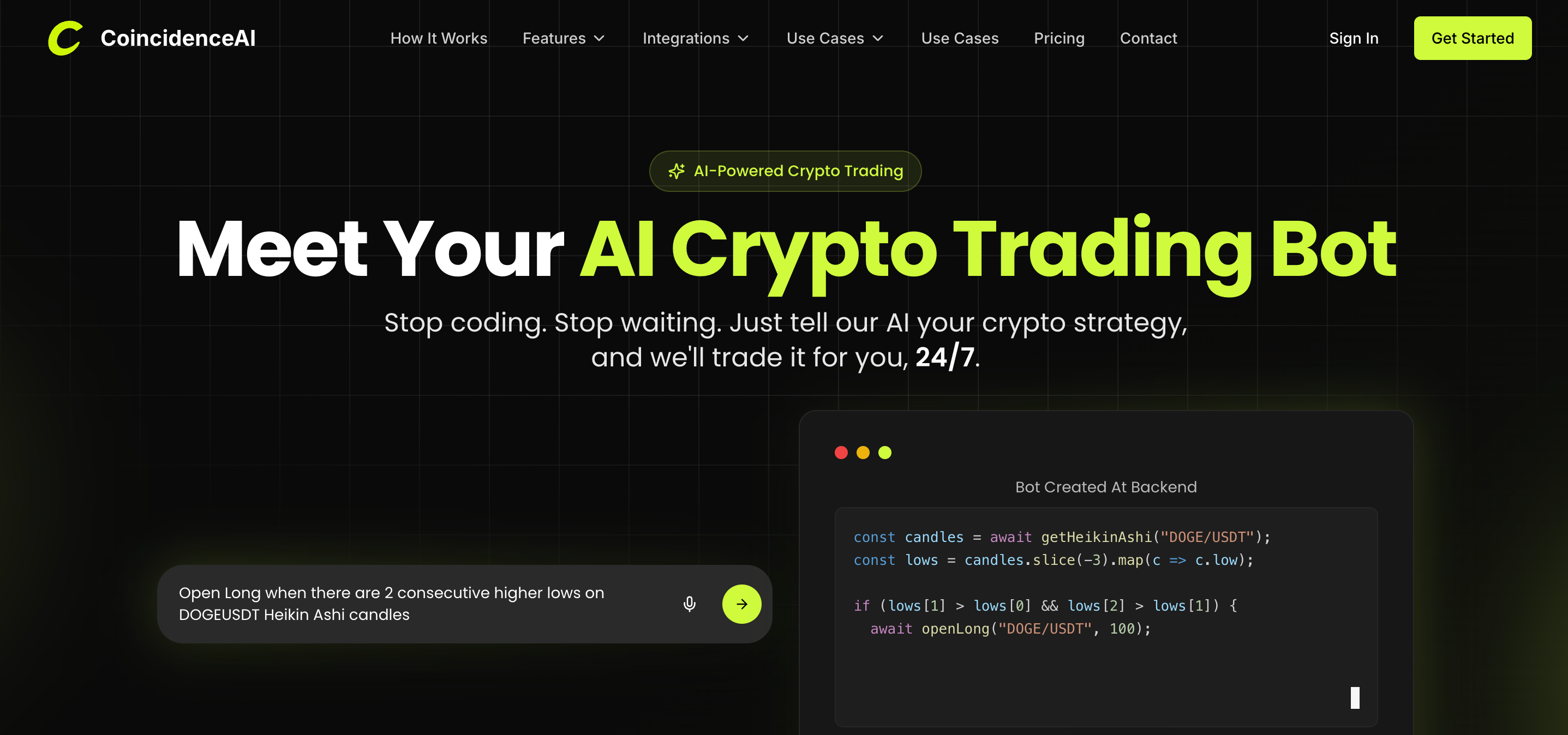
The shift from copying people to replicating logic changes the entire foundation of automated trading. You define the conditions that matter to you: entry thresholds, exit rules, position limits, and timeframes. The system translates that intent into executable structure without requiring you to write code or understand API documentation. This removes the dependency on another trader's judgment while preserving the automation that makes systematic execution practical.
Turning Ideas Into Testable Systems
You might specify that you want to enter long positions when Bitcoin crosses above its 50-day moving average while RSI stays below 70, exit when price drops 3% from entry, and risk no more than 2% of capital per trade. The platform interprets that logic, structures it into executable rules, and prepares it for validation.
This approach addresses a gap that stops most traders from moving beyond discretionary decisions. They understand market patterns conceptually but lack the technical skill to automate them. The translation layer removes that friction, allowing strategy development to focus on market logic rather than programming syntax.
Backtesting Before Committing Capital
Before deploying real money, the system runs your rules against historical price data across multiple market conditions. You see how the strategy would have performed during trending markets, choppy sideways action, and sharp drawdowns. This provides objective evidence rather than relying on someone else's track record that you cannot independently verify or reproduce.
The distinction matters because it shifts accountability. When you copy a trader and lose money, you're left guessing whether the strategy failed or whether execution differences caused the divergence. When you backtest your own rules and deploy them, performance becomes attributable to defined logic that you control and can adjust deliberately.
Automated Execution Across Multiple Exchanges
Once validated, strategies deploy directly to exchanges like Bybit or KuCoin. Trades execute automatically when predefined conditions trigger, eliminating the latency that plagues copy trading systems, where your order follows someone else's by seconds or minutes. The system monitors markets continuously, reacting to conditions faster than manual monitoring allows.
This removes the intermediary decision-maker entirely. There's no lead trader whose mood, availability, or sudden strategy shift affects your positions. The logic runs consistently whether markets are calm at midday or volatile at 3 am. If adjustments are needed, you update the rules explicitly rather than discovering changes only after positions are already open.
The Barrier to Systematization
Most traders handle automation by following someone else's decisions because building systematic strategies feels inaccessible without coding knowledge. As market conditions shift and follower counts grow, execution quality degrades. Slippage increases. The trader you're copying might change their approach mid-stream, exposing you to risks you never agreed to absorb.
Platforms like Coincidence’s AI crypto trading bot shift the model by letting you define strategy parameters in plain English, backtest them on real data, and deploy them across multiple exchanges with execution that responds to your rules rather than someone else's real-time judgment.
Transparency in Every Decision
You know exactly why each trade occurs because you specified the conditions. Risk management becomes explicit: stop losses, position sizing, and maximum drawdown thresholds. There's no mystery about what triggers an entry or why a position closed. Performance ties directly to the logic you validated, not to opaque decision-making hidden behind a leaderboard rank.
This transparency changes how you respond to losses. When a copied trade fails, you're left wondering whether the trader made a mistake or whether market conditions shifted. When your own strategy loses, you can examine whether the rules need adjustment or whether the loss falls within expected variance.
The difference between those two scenarios determines whether you improve systematically or chase performance blindly.
Owning Methodology Instead of Outsourcing Judgment
Strategy replication emphasizes control. You're not passively inheriting someone else's risk tolerance, leverage preferences, or psychological patterns. The system executes your defined process, scaled to your capital and aligned with your objectives. Adjustments happen deliberately, based on evidence from backtesting or live performance, not because someone you're copying decided to increase leverage after a losing streak.
This model suits traders who think in market terms but struggle with implementation. It removes the technical barrier without removing accountability. Performance becomes a function of whether your rules capture edge in current conditions, not whether the person you're following maintains discipline or continues trading the way they did when you started copying them.
Trade With Plain English With Our AI Crypto Trading Bot
If copy trading feels appealing but risky because you cannot see or control the underlying strategy, Coincidence AI lets you turn your own ideas into automated systems without coding. Describe your rules in plain English, backtest them instantly, and deploy live to supported exchanges.
Validated Logic Sovereignty
Start with one simple concept, validate it on historical data, and run it automatically without relying on another trader's decisions. This model suits traders who think in market terms but struggle with implementation. It removes the technical barrier without removing accountability.
Performance becomes a function of whether your rules capture edge in current conditions, not whether the person you're following maintains discipline or continues trading the way they did when you started copying them.