

The world of cryptocurrency offers opportunities beyond simple buying and holding, and futures trading represents one of the most powerful yet misunderstood tools for building wealth. Many beginners feel overwhelmed when they first encounter leverage, margin requirements, and contract expiration dates, but these concepts become manageable once you understand the fundamentals. This article breaks down crypto futures trading into digestible pieces, offering practical crypto trading tips that help you grasp position sizing, risk management strategies, and how to read market indicators without getting lost in technical complexity.
Coincidence’s AI crypto trading bot serves as your intelligent trading partner, executing strategies based on market conditions while you focus on understanding the broader principles of futures contracts, long and short positions, and portfolio diversification. The bot handles the technical execution and monitoring, allowing beginners to learn through observation and gradual participation rather than through trial and error.
Summary
- Crypto futures liquidations exceeded $1 billion on multiple single days during volatile periods, with over $19 billion in leveraged positions liquidated on October 10-11, 2025, alone. These weren't sophisticated traders caught by rare events. They were retail accounts using high leverage without calculating how much adverse movement their positions could absorb before automatic closure.
- Leverage creates asymmetric recovery requirements that beginners consistently underestimate. A 50% loss requires a 100% gain just to break even, and at 20x leverage, a position needs only a 2.5% adverse price move to lose half its value. The math compounds brutally because crypto routinely swings 5-7% daily during normal conditions, turning standard volatility into account-ending events.
- Perpetual futures charge funding rates every 8 hours, compounding to over 10% annually during strong trends. When combined with exchange fees and slippage, a 10x leveraged position might need a 10% price move just to break even after costs. Most beginners ignore this silent capital drain entirely, focusing only on directional movement while funding payments tighten liquidation thresholds regardless of whether price changes.
- Backtesting reveals whether strategies had a statistical edge under past conditions, yet most beginners deploy capital without any historical validation. A setup that feels intuitive might have lost money in fourteen of the last twenty comparable market environments. Without testing, traders discover these patterns only after burning through real capital on live positions.
- Professional traders calculate position size backward from acceptable loss (typically 1-2% of account equity), then use leverage for capital efficiency rather than profit amplification. Beginners invert this logic by starting with maximum available leverage and figuring out position size afterward, which turns routine volatility into unrecoverable drawdowns when stops become afterthoughts placed for comfort rather than as invalidation points.
AI crypto trading bot addresses this execution gap by converting plain-English strategy descriptions into automated systems that enforce predefined risk limits, execute stops without hesitation, and maintain statistical consistency across every trade without the emotional override that destroys manual trading performance.
Why Crypto Futures Attract Beginners and Trap Them

Leverage feels like discovery, not danger. You can control a $5,000 position with $500, and suddenly, the barrier between watching crypto markets and participating in them collapses. The math sounds clean: a 5% price move becomes a 50% gain with 10x leverage. What beginners miss is that losses scale identically. A 10% move against your position at 10x leverage doesn't just hurt. It erases your account entirely.
The Accessibility Illusion
Crypto futures exchanges have engineered simplicity around complexity. Opening a leveraged position requires:
- A few clicks
- Minimal capital
- No proof of experience
Platforms advertise low entry thresholds, sometimes as little as $10 to start trading contracts worth hundreds or thousands. The interface feels intuitive. The process feels democratic. The risk feels distant.
The Mechanics of the Countdown
Accessibility and safety are not the same thing. Derivative instruments carry liquidation mechanics that spot trading never introduces. When you buy Bitcoin on the spot market, the worst outcome is holding an asset that declined in value. You still own it. You can wait. With futures, margin requirements create a countdown.
If the market moves against you beyond a certain threshold, the exchange automatically closes your position to prevent further loss. You don't get to wait it out. Liquidation thresholds depend on leverage. At 10x, a 10% adverse move wipes you out. At 20x, it's 5%. At 50x, just 2%. Crypto's intraday volatility routinely exceeds these ranges.
Understanding Liquidation Trends in Volatile Markets
According to data aggregated by Coinglass, single-day liquidations across major exchanges have repeatedly surpassed $500 million during volatile periods, with some days exceeding $1 billion in forced closures. These aren't outliers. They're predictable outcomes when high leverage meets normal market behavior.
Social Proof and Survivorship Bias
Screenshots circulate constantly. A trader turns $200 into $3,000 overnight. Another posts a 400% weekly return. The wins are public, celebrated, and viral. The losses stay private. You don't see the 47 failed trades that preceded the one big win, or the accounts that blew up trying to replicate someone else's success.
Survivorship bias warps perception. When only the winners share their results, the strategy looks repeatable. Beginners assume successful traders possess a learnable edge, a pattern or indicator they can copy. What they're actually seeing is statistical noise.
The Contrast Between Luck and Edge in Constant Crypto Markets
In a market where thousands of traders take leveraged positions daily, some will inevitably hit extreme positive outcomes purely by chance. That doesn't make the approach sound. It makes it visible.
Crypto’s 24/7 market amplifies pressure because it never closes. Breakouts, liquidations, and funding shifts happen at any hour, even overnight. This constant motion creates fear of missing out. Beginners mistake nonstop activity for opportunity, when it’s often just exposure without edge.
The Revenge Trading Spiral
Rapid gains encourage position size increases. A beginner makes 30% in a day and immediately assumes they've cracked the code. The next trade uses:
- More capital
- Higher leverage
- Tighter stops
Confidence replaces caution. When that trade fails, the loss stings harder than the earlier win felt good. Loss aversion kicks in. Instead of stepping back, they double down, trying to quickly recover what was lost.
This isn't irrational. It's deeply human. Behavioral finance research consistently shows that losses hurt roughly twice as much as equivalent gains feel good. A $500 loss demands a $1,000 win just to feel emotionally neutral again. Under that pressure, risk management dissolves. Stops get ignored. Leverage gets pushed higher. Positions stay open longer than planned, hoping the market reverses.
Eliminating Emotional Bias With Automated Trading
Automated systems remove this emotional loop entirely. An AI crypto trading bot executes based on predefined rules, not psychological swings. When a stop loss triggers, the position closes without hesitation or negotiation. When a strategy hits its daily loss limit, trading halts regardless of how compelling the next setup appears.
The bot doesn't experience regret, fear of missing out, or the urge to prove itself right. It follows the plan every time, which is exactly what beginners struggle to do manually.
Funding Costs and Hidden Friction
Futures contracts aren't free to hold. Perpetual futures, the most common type in crypto, use funding rates to keep contract prices aligned with spot prices. Depending on market sentiment, you either pay or receive a small percentage every eight hours for keeping a position open. During strong trends, funding rates can exceed 0.1% per interval, which compounds to over 10% annually if held continuously.
Beginners often ignore this cost. They focus on price direction and leverage multiplier, treating the position like a turbocharged spot trade. But funding drains capital silently.
The Impact of Leverage and Hidden Costs on Breakeven Thresholds
A position that moves sideways for days can lose money purely through funding, even if the price hasn't dropped. Add exchange fees, slippage on entry and exit, and the spread between bid and ask, and the breakeven point shifts higher than most beginners calculate.
The math matters more at higher leverage. A 1% total cost (fees plus funding) on a 10x position effectively requires an 10% price move just to break even. On a 20x position, that same 1% cost demands a 20% move. In volatile markets, these thresholds seem reachable. In reality, they represent significant hurdles that eat into any edge a strategy might have.
Why Leverage Isn't the Enemy, But Misuse is
Leverage itself is neutral. Professional traders use it to efficiently allocate capital across multiple positions, manage risk through diversification, and express high-conviction views without tying up excessive collateral. The difference lies in position sizing, risk limits, and execution discipline.
Leverage as a Capital Efficiency Tool
Professionals rarely use the maximum available leverage. They calculate position size based on acceptable loss per trade, typically 1-2% of total capital. If a strategy risks $100 on a $10,000 account, the position size adjusts to ensure that the stop loss level is reached regardless of the leverage used. Leverage becomes a tool for capital efficiency, not profit amplification.
The Trap of Leverage-First Sizing
Beginners invert this logic. They start with leverage, then figure out position size. "I have $500 and want to use 10x leverage, so I'll open a $5,000 position." The stop loss becomes an afterthought, placed wherever it feels comfortable rather than where the strategy is invalid. When volatility spikes, that comfort zone evaporates in minutes.
The pattern repeats across exchanges, across coins, across market cycles. Accounts grow explosively, then collapse just as fast. Not because the trader chose the wrong direction, but because leverage turned normal volatility into an unrecoverable drawdown.
Related Reading
- Crypto Trading Tips
- Crypto Backtesting
- Dca Bot Vs Grid Bot
- What Is Wash Trading
- Automated Trading Over Manual Trading
- What Is Long And Short In Crypto Trading
- What Is Swing Trading Crypto
- How Does Crypto Leverage Trading Work
- Forex Crypto Trading
What are Crypto Futures?

A crypto futures contract is an agreement that gives exposure to price movements without owning the underlying asset. When you trade Bitcoin futures, you're not buying Bitcoin. You're entering a derivative contract that tracks its price. If Bitcoin rises 5%, your contract's value generally rises 5%.
If Bitcoin falls 10%, your contract drops 10%. The critical distinction is ownership. In spot trading, you hold the asset. In futures, you hold a contract representing price exposure. This difference reshapes everything about risk, capital requirements, and how quickly you can lose money.
Contracts Derived From Underlying Assets
Futures contracts derive their value from an underlying cryptocurrency, such as Bitcoin or Ethereum. The contract mirrors price action but introduces mechanics that spot trading never involves. You're not storing anything in a wallet. You're not transferring ownership. You're taking a position on whether the price will move up or down, and the exchange tracks your profit or loss in real time based on that movement.
Ownership matters because it determines what happens when markets turn volatile. With spot holdings, you can wait through drawdowns. The asset remains yours until you choose to sell. With futures, margin requirements create a threshold. Cross it, and the exchange closes your position automatically. You don't get to hold and hope.
Perpetual Futures vs Dated Contracts
Two main types of futures dominate crypto markets. Dated futures contracts expire on a specific date and settle automatically in cash or through asset delivery, depending on the contract structure. Perpetual futures, often called perps, never expire. Instead, they use a funding rate mechanism to keep the contract price aligned with the spot market.
Perpetuals dominate because they let traders hold positions indefinitely, as long as the margin stays sufficient. According to Cointelegraph, crypto derivatives volume exploded to $86 trillion in 2025, with perpetual contracts accounting for the majority of that activity. The flexibility appeals to traders who don't want to manage rollover dates or worry about expiration timing.
But that flexibility comes with ongoing costs. Funding rates charge or pay you every eight hours based on market sentiment. If perpetual prices trade above spot, longs typically pay shorts. If they trade below, shorts pay longs. Over weeks or months, these payments add up, quietly eroding capital even when price action moves sideways.
Long and Short Positioning
Futures allow you to profit whether prices rise or fall. Going long means you profit if the price increases. Going short means you profit if the price decreases. In spot markets, shorting requires borrowing the asset, which introduces complexity and often higher fees. In futures markets, opening a short position takes the same effort as opening a long.
This symmetry attracts traders who want to capitalize on bearish conditions without the friction of borrowing. It also creates the illusion that futures trading is just spot trading with more options. It's not. The ability to short easily doesn't eliminate risk. It doubles the directions from which liquidation can strike.
Funding Rates and Liquidation Mechanics
Perpetual futures rely on funding rates to anchor contract prices to spot markets. At regular intervals, one side of the market pays the other. The exchange doesn't collect this fee. It flows directly between traders. When funding rates spike during strong trends, holding a position becomes expensive.
A 0.1% funding rate every eight hours compounds to over 10% annually if you never close the position.
Many beginners struggle to understand that liquidation is not optional. The exchange doesn't ask if you'd like to close your position when margin runs low. It closes automatically to prevent your account from going negative and creating a liability for the platform. At 10x leverage, a 10% adverse price move eliminates your margin entirely. At 20x, it's 5%. At 50x, just 2%.
The Predictability of Forced Exits
Crypto's intraday volatility routinely exceeds these thresholds. A coin can swing 8% in an hour during normal market conditions, 15% during volatile periods, and 30% or more during major news events. Liquidation isn't a rare edge case. It's a predictable outcome when leverage meets normal price behavior.
Traders who manually monitor positions face a constant dilemma.
- Do you set tight stop losses and get shaken out by noise, or do you set wide stops and risk larger losses?
- Do you check prices every hour, or do you sleep and hope volatility doesn't spike overnight?
AI crypto trading bot removes this tension entirely by executing predefined risk rules without hesitation or second-guessing. When a stop loss triggers, the position closes immediately. When the margin falls to dangerous levels, the system automatically reduces exposure. The bot doesn't experience fatigue, distraction, or the temptation to "give it one more hour."
How Futures Differ From Buying Spot Crypto
Spot trading means you pay in full and own the asset. There's no liquidation unless you choose to sell. Volatility may cause drawdowns, but the asset remains yours. You can hold through corrections, wait for recovery, or sell at your discretion.
Futures trading introduces leverage, margin requirements, liquidation risk, and funding payments. Instead of holding an asset long term, you're trading price exposure within a structured contract system. The contract has rules. Break them by letting your margin fall too low, and the exchange enforces closure automatically.
The Speculative Countdown
The distinction between owning an asset and holding a contract isn't just technical. It's the difference between weathering a storm and getting swept out to sea. Futures magnify both gains and losses, compress timeframes, and eliminate the luxury of patience. You're not investing. You're speculating with a countdown timer attached to every position.
How Leverage Works and Why It's Dangerous
When you use 10x leverage, a 5% price move in your favor generates a 50% return on your margin. The same 5% move against you erases half your account. According to CryptoNinjas, 10x leverage transforms routine volatility into account-ending events, yet exchanges present it as a standard option requiring no special qualifications. The math is symmetrical, but the psychological impact isn't. Gains feel earned. Losses feel like theft.
Margin as Collateral, Not Ownership
You don't need $10,000 to control a $10,000 position. At 10x leverage, you post $1,000 as margin. The exchange effectively lends you the remaining $9,000 in exposure. Your margin acts as a buffer against losses. When the price moves against you, losses are deducted from that buffer first. Once your margin falls below the maintenance threshold, liquidation is triggered automatically.
This isn't a courtesy call. The exchange doesn't ask if you'd like more time. The position closes instantly to prevent your account from going negative and creating liability for the platform. At 10x leverage, roughly a 10% adverse move liquidates you. At 20x, it's 5%. At 50x, a 2% swing ends the trade.
Crypto routinely moves 5% in an hour. Altcoins swing 10% or more during normal trading days. The leverage that felt like an opportunity becomes a countdown timer measuring how long you can survive standard volatility.
Compounding Losses and Recovery Math
A 50% loss requires a 100% gain just to break even. At high leverage, reaching that 50% loss happens fast. A position opened at 20x leverage needs only a 2.5% adverse price move to lose half its value. Recovering from that point demands not just better timing, but exponentially better performance.
The Mathematical Trap of High Leverage
Beginners underestimate how quickly leverage converts small mistakes into unrecoverable holes. One bad trade at 10x leverage can erase the gains from five winning trades at the same leverage level. The asymmetry isn't in the math. It's in the emotional aftermath. After a significant loss, the urge to recover quickly intensifies.
Position sizes grow. Leverage increases. Risk management dissolves under the pressure to get back to even.
Breaking the Psychological Cycle with Automated Trading
Manual traders constantly fall prey to this psychological trap. Automation removes it entirely. An AI crypto trading bot executes predefined risk limits without emotional interference. When daily loss thresholds trigger, trading stops regardless of how compelling the next setup appears. The system doesn't feel the sting of prior losses or the temptation to prove itself right. It follows the plan every time, which is exactly what high-leverage environments demand.
Position Sizing Determines Survival
Professional traders calculate position size backward from acceptable loss, not forward from available leverage. If you're willing to risk $100 on a trade, and your stop loss sits 5% below entry, your position size should be $2,000 regardless of whether you're using 2x or 20x leverage. Leverage becomes a tool for capital efficiency, not profit amplification.
Strategic Priority of Position Sizing
Beginners invert this sequence. They start with leverage, then figure out position size. "I have $1,000 and want to use 10x leverage, so I'll open a $10,000 position." The stop loss becomes an afterthought, placed wherever it feels comfortable rather than where the strategy is invalid. When volatility spikes, comfort zones vanish in minutes.
The difference isn't knowledge. It's discipline. Knowing you should risk 1% per trade doesn't help when a 3% pullback feels temporary, and you convince yourself to hold through it. By the time you admit the trade failed, the loss exceeds 5%, and your account can't absorb enough future trades to recover statistically.
Funding Costs Drain Positions Silently
Perpetual futures charge funding rates every eight hours. During strong trends, these rates spike. A 0.1% funding rate per interval compounds to over 10% annually if you never close the position. Add exchange fees and slippage, and a 10x leveraged position might need a 10% price move just to break even after costs.
The Silent Drain of Funding Rates
Most beginners ignore this friction. They focus on direction and leverage multiplier, treating futures like turbocharged spot trades. But funding accumulates whether the price moves or not. A position held for two weeks during a sideways market can lose 2-3% purely through funding, even if the entry price never changed. That silent bleed tightens liquidation thresholds and reduces the margin available to weather volatility.
The math gets worse as leverage increases. A 1% total cost on a 20x position effectively demands a 20% price move to break even. In theory, volatile markets make that reachable. In practice, it represents a significant statistical hurdle that most strategies can't consistently clear.
Why Volatility and Leverage Don't Mix
Crypto doesn't move in straight lines. A 15% rally often includes three 5% pullbacks along the way. At 20x leverage, those pullbacks liquidate long positions even when the overall trend proves correct. You can be right about direction and still lose everything because the path to being right included normal volatility that your leverage couldn't absorb.
This isn't rare. It's the default outcome when high leverage meets real market behavior. Traders watch their thesis play out exactly as predicted, but their position closed hours earlier during a brief spike that meant nothing to spot holders. The spot trader weathers the turbulence and profits. The leveraged trader gets liquidated and misses the move entirely.
The failure isn't in the analysis. It's in the mismatch between leverage and the asset's natural movement pattern. Crypto's volatility hasn't decreased. Leverage hasn't become safer. The gap between the two remains as wide as ever.
Related Reading
- What Is OTC Trading Crypto
- What Are Crypto Trading Signals
- Most Profitable Crypto Trading Strategy
- Best App For Crypto Day Trading
- Best Crypto to Day Trade
- Best Crypto Copy Trading Platform
- Best Crypto Trading Tools
- Crypto Futures Trading for Beginners
- Crypto Day Trading Strategies
- Best Crypto Trading Platform
- Advanced Crypto Trading Strategies
The Real Reason Most Beginners Lose
Most beginners believe they lose because they lack the right indicator or secret strategy. In reality, losses usually stem from poor execution rather than insufficient tools. The edge is rarely missing. Discipline is.
Overtrading
Crypto markets operate 24/7, creating the illusion that opportunity is constant. Beginners often open too many positions, chasing every movement. Data from major derivatives exchanges shows that retail accounts with high trade frequency tend to underperform those with lower frequency, largely due to:
- Fees
- Slippage
- Impulsive entries
The more decisions you make, the more chances you have to deviate from a plan.
Each trade carries transaction costs. Each position demands mental bandwidth. Each decision point introduces emotion. Overtrading compounds risk because leverage magnifies every mistake. A trader who opens fifteen positions in a week at 10x leverage doesn't have fifteen chances to profit. They have 15 chances to blow through their stop-loss before the strategy proves itself.
Strategic Patience vs. Market Noise
The 24/7 nature of crypto intensifies this pattern. There's always a chart moving, always a setup forming, always a reason to act. Beginners interpret constant market motion as a constant opportunity, when often it's just noise that punishes participation. The trader who waits for high-probability setups preserves capital. The trader who chases every move bleeds it away through friction.
No Clear Entry and Exit Rules
Many beginners enter trades based on vague signals such as "it looks bullish" or "Twitter is optimistic." Without predefined entry, stop-loss, and take-profit criteria, decisions become reactive. When price moves slightly against them, fear triggers early exits. When price moves in their favor, greed delays profit-taking.
This inconsistency destroys the statistical edge. Even a strategy with a 55% win rate can fail if exits are random. You can be right about the direction and still lose money because you closed too early, held too long, or moved your stop-loss, hoping for a reversal that never came.
Confronting Inconsistencies in Manual Trading Decisions
Traders who manually manage positions face this tension constantly. Do you honor the stop loss you set yesterday, or do you give it "just a bit more room" because the setup still looks valid? Do you take profit at your target, or do you hold for a bigger move? Every decision carries doubt. Every adjustment introduces inconsistency.
Platforms like an AI crypto trading bot remove this internal negotiation entirely. The system executes predefined entry and exit rules without hesitation. When a stop loss triggers, the position closes immediately, no second-guessing. When profit targets are hit, the trade exits automatically.
The bot doesn't experience the urge to adjust mid-trade or the temptation to "see what happens next." It follows the plan every time, which is exactly what high-leverage environments demand.
Inconsistent Risk Management
Professional traders define risk before entering a position. Beginners often define risk after the market moves. A common mistake is risking too much capital per trade. Risking 20% of an account on one position means just five consecutive losses can reduce equity by roughly two-thirds. Recovery then requires disproportionate gains.
According to public liquidation trackers, billions of dollars in leveraged crypto positions are liquidated each month during volatile periods, illustrating how widespread poor risk management is among retail traders. In a historic event, over $19 billion in leveraged crypto positions were liquidated in a single day, on October 10-11, 2025, after a sudden market crash.
These weren't sophisticated traders caught by black swan events. These were accounts that entered positions without calculating how much adverse movement they could absorb.
The Geometric Reality of Drawdowns
The math is unforgiving. A 50% loss requires a 100% gain to recover. A 75% loss requires a 300% gain. Once you dig a deep enough hole, the statistical probability of climbing out collapses, even with a profitable strategy. Risk management isn't about avoiding losses. It's about ensuring losses never grow large enough to make recovery impossible.
Manual Trading Errors
Manual execution introduces latency and emotion. Traders hesitate, misclick, adjust stops impulsively, or widen losses in hopes of a reversal. Behavioral finance research has consistently shown that individual investors underperform market benchmarks due to timing errors driven by emotion rather than information deficits. The issue is rarely a lack of knowledge. It is an inconsistent application.
You know you should cut losses quickly. But when your position sits 8% underwater, and the chart looks like it might reverse, cutting feels premature. You know you should let winners run. But when your position hits 15% profit, and you remember last week's trade that reversed after similar gains, taking profit feels prudent.
These aren't irrational decisions in isolation. They're human responses to uncertainty. The problem is they're inconsistent, and inconsistency erodes edge faster than bad analysis.
Failure to Backtest
Many beginners deploy capital without validating their ideas against historical data. Without backtesting, they have no statistical basis for confidence. Backtesting does not guarantee future performance, but it reveals whether a strategy had an edge under similar past conditions. Trading without it is closer to speculation than structured execution.
Moving Beyond Intuition With Data
A strategy that feels intuitive might have lost money in twelve of the last fifteen similar market conditions. You won't know until you test it. A setup that looks compelling on one chart might fail consistently when applied across multiple assets or timeframes. Backtesting surfaces these patterns before they cost real capital.
Discipline is the Missing Edge
The pattern is consistent. Beginners lose not because markets are impossible to trade, but because they trade without structure. They enter without rules, emotionally size up positions, ignore defined exits, and react rather than execute.
Indicators and tools can support performance, but they cannot enforce discipline. In leveraged environments like crypto futures, execution consistency matters more than analytical sophistication. The real edge is not another indicator. It is the ability to follow defined rules repeatedly without deviation.
What a Beginner-Friendly Futures Setup Looks Like

A beginner-friendly futures setup prioritizes survival over spectacular returns. It assumes you will make mistakes, misread markets, and misjudge volatility. The structure compensates for these inevitable errors by limiting their damage. According to tastytrade, futures contracts typically require 3-10% of the contract value as margin, which means even conservative leverage can create significant exposure if not managed properly.
Risk Per Trade Caps Catastrophic Loss
Every position begins with a predetermined loss threshold, usually 1 to 2% of total account equity. This isn't a suggestion. It's the boundary that determines whether ten consecutive losing trades reduce your account by 10% or obliterate it entirely. The difference between risking 1% and 5% per trade isn't incremental. It's the difference between statistical recovery and emotional collapse.
Calculate position size backward from this threshold. If your account holds $10,000 and you risk 1%, that's $100 per trade. If your stop loss sits 5% below entry, your position size cannot exceed $2,000, regardless of available leverage. The leverage you use becomes irrelevant to the calculation.
What matters is how much you lose when you're wrong, not how much you control when you're right.
Leverage as a Tool, Not a Multiplier
Professional traders use 2x to 5x leverage for capital efficiency, not to accelerate profits. Lower leverage increases the price distance your position can absorb before liquidation. A 5% adverse move at 5x leverage reduces your margin by 25%. The same move at 20x leverage liquidates you entirely.
Crypto moves 3 to 7% daily during normal conditions. Using 20x leverage in that environment doesn't give you twenty times the opportunity. It gives you twenty times the exposure to routine noise. Your thesis might prove correct over three days, but if the path includes a 6% pullback on day one, you never see day two.
Entry Conditions That Remove Interpretation
Vague signals like "looks strong" or "momentum building" create inconsistency. Rule-based entries eliminate interpretation. Price must cross above the 50-period moving average. Volume must exceed the 20-day average by 30%. RSI must rise above 60 after spending three bars below 40. These conditions either occur or they don't. There's no room for "almost" or "probably."
This objectivity allows backtesting. You can measure how often these conditions led to profitable trades over the past year across multiple assets and in different volatility regimes. Without objective rules, backtesting becomes impossible. You're left guessing whether your strategy works or whether you got lucky three times in a row.
Stop Losses Placed By Structure, Not Comfort
A stop loss protects capital before it is liquidated. Placing it requires logic, not emotion. For long positions, stops go below recent support levels, swing lows, or volatility-adjusted thresholds. The distance between entry and stop determines position size, not the other way around.
If you enter at $50,000 with support at $48,000, your 4% stop allows a $2,500 position on a $10,000 account, risking 1%. If the stop widens to 8%, your position size drops to $1,250.
The market determines your stop distance. Your stop distance determines your position size, not your opinion.
Validation Through Historical Performance
Deploying capital without backtesting is speculation dressed as strategy. Backtesting reveals whether your rules produced positive expectancy under past conditions similar to today. A strategy might feel intuitive, but it has lost money in 14 of the last 20 comparable setups. You won't discover that through intuition. You discover it by testing.
Profitability Through Positive Expectancy
Measure win rate, average gain versus average loss, maximum consecutive losses, and drawdown depth. A 45% win rate can still generate profit if winners average twice the size of losers. A 60% win rate can still destroy accounts if 40% of losses are catastrophic. The distribution matters more than the headline percentage.
Most beginners handle this manually, adjusting stops mid-trade when volatility spikes or holding positions past their exit signal, hoping for reversals.
Platforms like AI crypto trading bots execute strategies exactly as backtested, without emotional override. When predefined conditions are triggered, the system acts immediately. No second-guessing. No, hoping the market comes back. The bot consistently follows the statistical edge you validated, which is the only way edge translates into compounding returns over time.
Automation Removes the Weakest Link
Even perfectly designed strategies fail when executed inconsistently. You know the stop loss should trigger, but the chart looks like it might reverse. You know the position should close at the target, but momentum feels strong enough to run further. These hesitations feel rational in the moment. Over time, they erode the edge faster than poor analysis ever could.
Automation enforces the plan without negotiation. Entries occur when conditions align. Stops execute when thresholds break. Positions close when targets are hit or time limits expire. The system doesn't experience regret, fear of missing out, or the urge to prove yesterday's decision was correct. It treats every trade as independent, which is exactly how probability works, but not how human psychology operates.
The Blueprint for Repeatable Success
A beginner-friendly setup isn't about finding perfect entries or predicting exact reversals. It's about building a repeatable process that limits damage during inevitable mistakes and captures the edge when conditions align. Risk gets defined before entry. Leverage stays conservative. Rules stay objective. Stops stay logical. Strategy gets validated. Execution stays consistent.
Related Reading
- Best Crypto Prop Trading Firms
- Best Crypto Leverage Trading Platform USA
- Best Crypto Options Trading Platform
- Best Crypto Paper Trading
- Best Crypto Trading Simulator
- Coinrule Alternative
- Cryptohopper vs 3Commas
- HaasOnline vs 3Commas
How Coincidence AI Helps Beginners Trade Futures Systematically
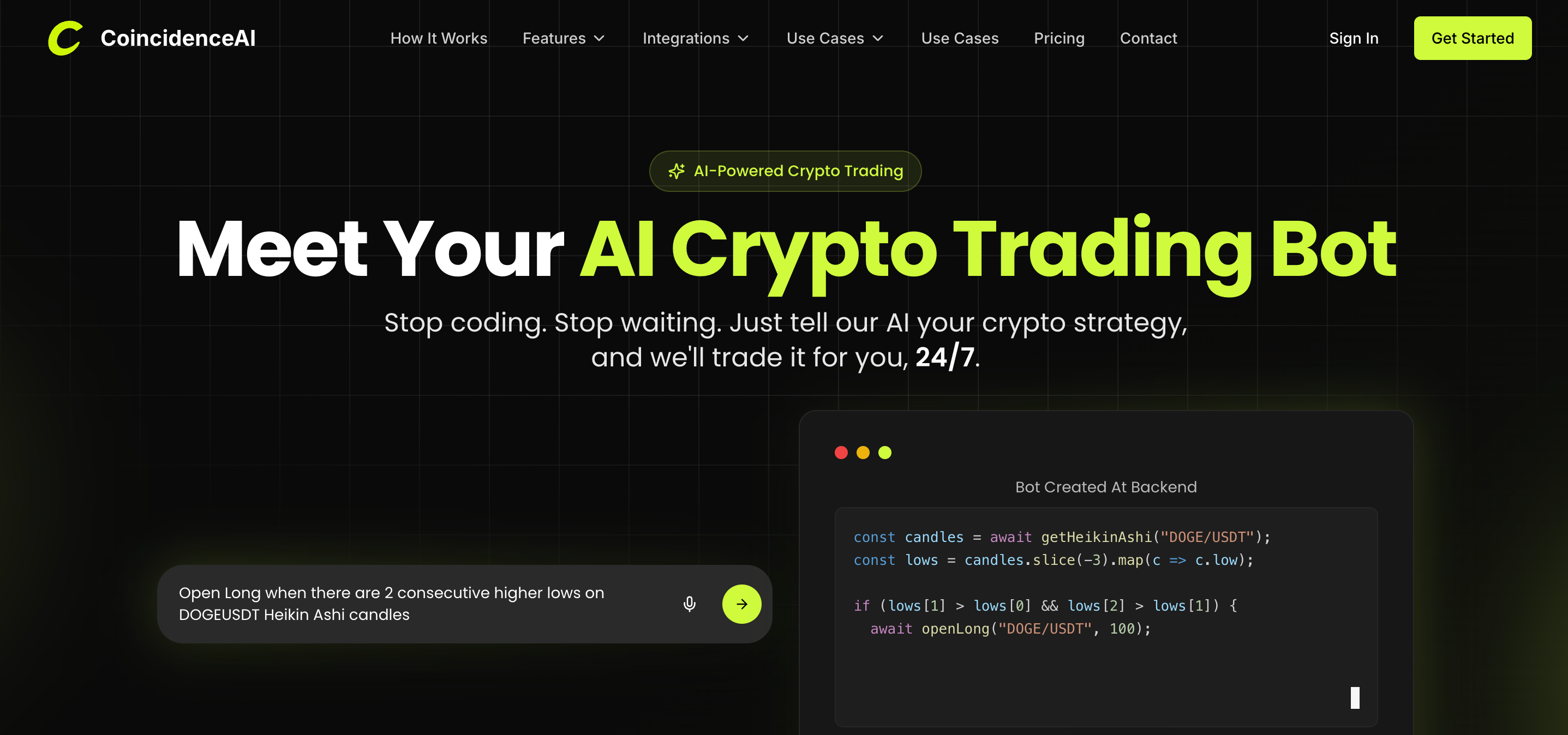
Execution errors kill more accounts than bad analysis. You can identify perfect setups, understand leverage mechanics, and calculate position sizes correctly, but none of that matters if you hesitate during entry, widen stops mid-trade, or close positions emotionally. Coincidence AI eliminates that gap by converting strategy into automated execution that runs without psychological interference.
Turn Plain-English Rules Into Executable Logic
You don't need programming skills or technical infrastructure. Describe your strategy in conversational language: enter long when price crosses above the 50-period moving average, risk 1% per trade, set stop loss at the recent swing low, take profit at twice the risk. The system translates those instructions into precise trading logic that executes exactly as written.
This forces clarity before capital deploys. Vague ideas like "buy when momentum builds" don't translate into code. You must define what momentum means, which indicators measure it, and what threshold triggers action. That requirement alone prevents most beginner mistakes, because ambiguous strategies can't be automated.
Instant Backtesting Against Real Futures Data
Most beginners trade ideas without validation. They see a pattern once or twice, assume it works, and risk real money. Coincidence AI lets you test strategies against historical futures data instantly. You evaluate win rates, maximum drawdowns, risk-to-reward ratios, and performance during volatile periods before placing a single live trade.
According to LiquidityFinder, AI-driven trading systems now handle 89% of the world's trading volume, largely because institutional traders demand backtested validation before deployment. Retail traders gain access to the same validation process without needing quantitative teams or proprietary data feeds.
Empirical Validation Over Intuition
Backtesting shifts trading from guessing to probability assessment. A strategy that feels intuitive might lose money in fourteen of the last twenty similar conditions. You discover that through testing, not through burning capital on live positions. The system surfaces patterns invisible to manual observation, like how your strategy performs during:
- Specific volatility regimes
- Time-of-day windows
One-Click Deployment to Exchanges
Once validated, strategies deploy directly to supported exchanges like Bybit and KuCoin. No manual signal execution. No copying trade parameters between platforms. The system monitors conditions continuously and executes when your predefined rules align, regardless of whether you're awake, distracted, or second-guessing yourself.
Crypto futures move 24/7. Significant breakouts happen at 3 a.m. Liquidation cascades trigger during weekends. Funding rates shift while you sleep. Manual traders miss opportunities or wake up to find their positions liquidated because they can't monitor markets constantly. Automation doesn't sleep, doesn't get distracted, and doesn't hesitate when conditions match your criteria.
Continuous Execution Without Emotional Override
Fear widens stops. Greed removes them. Hesitation misses entries. Regret keeps losing positions open too long. Every manual decision carries emotional weight that distorts execution. Platforms like AI crypto trading bots enforce discipline by executing predefined rules without internal negotiation.
When a stop loss triggers, the position closes immediately. When profit targets are hit, the trade exits automatically. Risk parameters remain consistent across every trade.
The Crucial Role of Consistency in Trading Success
Consistency matters more than most beginners realize. A strategy with 55% win rate and 2:1 reward-to-risk ratio generates profit over time, but only if executed identically on every signal. Manual traders deviate. They skip risky entries, hold losers that look temporary, and exit winners early when profit is sufficient. Those deviations destroy statistical edge faster than poor analysis ever could.
Removes the Coding Barrier Entirely
Traditional algorithmic trading requires programming knowledge, API integration, server management, and constant maintenance. Coincidence AI removes that technical barrier completely. You think in strategy, not syntax. You describe what should happen, not how to make it happen through code.
This accessibility allows beginners to adopt systematic trading without needing quantitative backgrounds or development skills. The focus stays on strategy design, risk management, and market understanding rather than debugging scripts or managing infrastructure failures.
A Structured Path Through High-Risk Environments
Crypto futures amplify both opportunity and risk. Systematic approaches reduce avoidable mistakes by enforcing:
- Defined risk per trade
- Clear entry and exit logic
- Pretested strategies
- Consistent execution
The system doesn't guarantee profits. It guarantees that losses stay manageable and execution stays disciplined.
Most beginners lose not because markets are impossible to trade, but because they execute inconsistently under pressure. They know the rules but break them when emotions spike. Automation solves the hardest problem in trading, the gap between knowing what to do and actually doing it when capital is at risk.
Trade With Plain English With Our AI Crypto Trading Bot
If you want to trade futures without relying on emotion or guesswork, describe your strategy in plain English inside Coincidence AI, backtest it instantly, and deploy it live to your exchange in minutes. Start with rules, not hype, and let your system execute with discipline around the clock.
Mastering Execution Consistency in Futures Trading
The gap between understanding futures mechanics and profiting from them isn't a matter of knowledge. It's execution consistency. You've learned how leverage amplifies losses, why funding rates erode positions, and how liquidation thresholds compress survivability. That information becomes useful only when applied identically across every trade without:
- Hesitation
- Adjustment
- Internal negotiation that manual trading demands
Automation converts strategy into repeatable action, removing the psychological friction that destroys accounts faster than poor analysis ever could.